
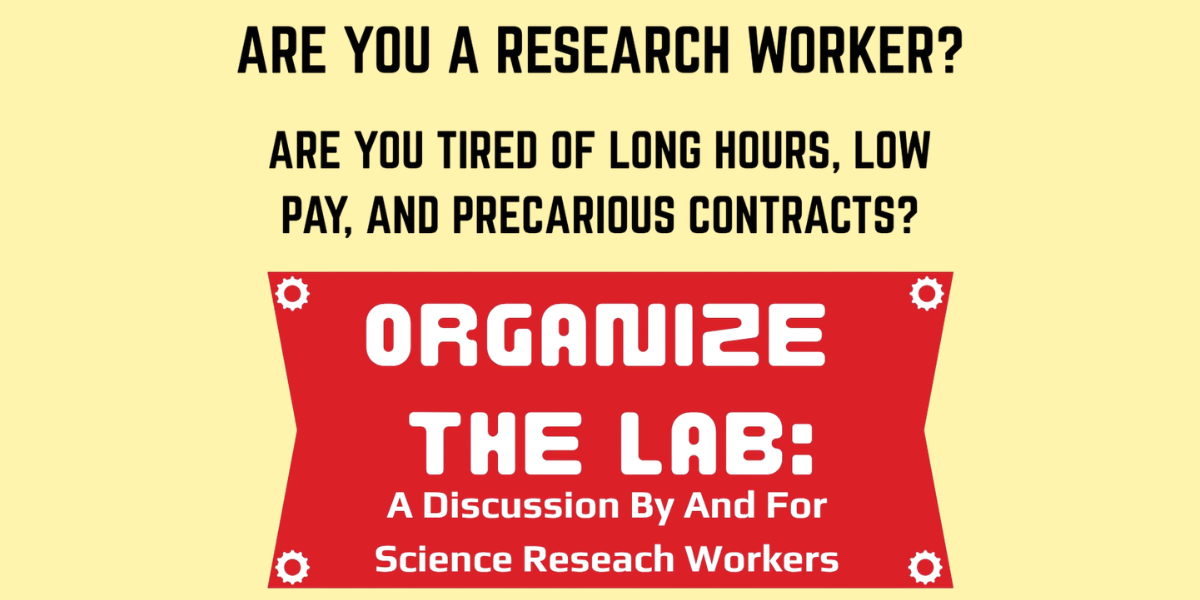
Research workers gathered in Toronto on July 21 to launch the Organize the Lab campaign, led by the Toronto chapter of Science for the People ‘Canada.’ Research workers from hospitals and universities across the city gathered to discuss their work conditions and how workers can better organize their workplaces. The frustration in the room was palpable. Research workers are tired of precarious contracts, tired of working overtime without adequate pay, and tired of being mistreated without any support.
The event served as a teach-in and discussion forum for workers to safely and plainly discuss the issues they face, identify their causes, and brainstorm solutions. The teach-in portion involved short presentations on the systemic conditions that impact research workers, the ways our work as labour are mystified, and explore how other research workers like us are organizing for labour rights. An anonymized vignette of a Toronto-based research worker was shared at the start of the meeting to illustrate common experiences of burnout and pressure from bosses to, as one attendee put it, “exploit ourselves”:
Sara had been working as a temporary research staff at a research laboratory at a major hospital for 2 years, working 70 hour weeks and not getting paid overtime, instead accruing it as “in lieu” vacation time, for which there is no coverage to even take.
She managed four research projects and her department had her picking up extra administrative tasks to support short-staffing of the overall department.
During a four month short-term disability leave due to burnout (covered by Employment Insurance), her boss repeatedly contacted her, pressuring her to return to work. Her boss even threatened to call the police for a “wellness check” if she didn’t reply.
Sara ignored this and returned to work on the agreed upon date. There was no return-to-work transition plan and her boss told her that she needed to catch up on everything she missed over the past four months by the end of the day. Sara contacted HR and requested a mediated conversation with the laboratory manager.
An hour later, HR called her back to say her contract was dissolved due to “a lack of sufficient funds for the project she is working on.”
Research work is work
The profits from knowledge production are not as clear as with other commodities, as working in science is regularly framed as “working for the betterment of humanity.” Attendees described how “siloed” workplaces make it difficult to build solidarity among workers. The lines between yourself as a worker and the boss (also known as scientist or PI/Principal Investigator) are blurred to make it seem like you are collaborators with a shared passion, despite different material work conditions.
Attendees described “the lack of class consciousness” as a core issue in research workplaces. One attendee described how “organizing research workers is disappointing and hard” because of “a lack of solidarity because research work is seen as temporary or that the PI is nice to them.” As argued in “The Scientific Factory Floor: How Capitalism Alienates Researchers” by Renu Kumari, research workers are alienated because the worker produces knowledge (the product) over which they have no ownership (it is owned by the boss) or influence (research workers must adhere to the ideas of the PI, fulfill mechanized tasks and are rarely given space to propose their own ideas for grants or projects). Research workers are paid a wage by their boss, and therefore are workers protected by labour laws and entitled to no exploitation.
Exploitation in research work
The teach-in presentations were followed by discussions where research workers shared and validated each other’s experiences. Research workers are highly vulnerable to exploitation due to a system that one attendee referred to as “feudalism,” whereby bosses receive prestigious grant funding to hire workers but receive little to no oversight from the institution as to how those workers are treated, thereby regularly escaping accountability for poor working conditions.
This creates a double-bind for workers who often rely on a favourable impression by the boss as necessary to advance out of a current position. As a result, research roles are often perceived as temporary stepping stones to higher pay, resulting in workers being less likely to agitate for improved work conditions if they plan on leaving. The vast majority of research roles are temporary contracts. Attendees had either directly experienced or witnessed fellow workers be easily terminated without cause or prior notice due to “insufficient budget.”
Research workers are also aware that these roles are highly competitive and are made to feel they are easily replaceable. Immigration status can also be weaponized, where workers receive implicit and explicit threats of being sent home or risk of losing immigration status to stay in Canada.
Many research workers are legitimately passionate about their field of work, which makes asserting boundaries or reminding bosses about labour laws difficult out of fear of reprisal. Many attendees described fearing a “whisper network” of bosses within various fields of scientific research which can lead to future work opportunities being withheld from workers. Thereby, job stability within research becomes the carrot on the stick with which bosses keep workers from questioning them, which is ironic in a field built on critical thinking and asking questions.
The components of exploitation described during the teach-in resonated with many attendees. Workers described that research is “supposed to be seen as a vocation” and that overtime is an expected part of the job. Multiple workers described instances where their boss asked them on a weekend to complete a newly assigned task by Monday morning.
Intentionally fluid or undefined roles and responsibilities with language such as “other duties as assigned” in the official job descriptions mean that bosses frequently ask workers to take on tasks outside of a standard job description. As mostly non-unionized workers, research workers have no way to know when they’re working outside of a job description and the only person to discuss grievances with is HR, which can often take the form of an individual administrator rather than a centralized department.
Poor material conditions and safety issues
Repeated temporary contracts mean that workers are often stressed about their contract getting renewed so they can afford rent and food, working multiple jobs to support themselves, and lacking health insurance. This recurring cycle of chronic burnout is common. Burnout and lack of oversight due to understaffing research teams can also lead to incidental mistakes that risk harming patients. Research participants, often patients looking for new care options or wanting to help others, are subject to the safety protocols dependent on each scientist.
Enforcement of safety protocols is underpinned by the incentives in place for scientists: to publish as many peer-reviewed research articles as possible, obtain personal accolades that lead to promotion and prestige, and obtain more funding. While Research Ethics Boards at each hospital exist to protect patients, these are often seen by scientists as barriers to initiating a study and not as an important step to prioritize patient well-being throughout the study.
Connecting struggles
Workers didn’t just highlight the impacts of poor work conditions on their own lives, but illustrated how the issues they face are connected with others. In fact, one attendee described how a recent round of layoffs at a major Toronto hospital “just happened to include the same workers organizing an internal letter about solidarity with the people of Palestine.” Bosses expect workers to research health issues domestically whilst remaining quiet about the genocide in Palestine and destruction of the healthcare system, including neonatal units and maternity wards.
Just last week, workers in England from the Institute of Cancer Research (ICR) (including researchers, porters, maintenance and administrative staff), have escalated their strike over pay. This is the centre’s first industrial action in their 117 year history due to an “existential crisis.” Workers at the centre are reportedly skipping meals and unable to pay bills. They have experienced a 16% reduction in real terms wages while the CEO, Kristian Helin, has reportedly increased his pay by 55%.
At home in Ontario, The Crisis of Wage Theft in Ontario report by the Workers Action Centre revealed that over the last decade, employees are owed $80 million in unpaid wages and that the Provincial government failed to ensure employers return these stolen wages. Stolen wages are also widespread in research work. In 2022, the clinical research sector generated $18.4 billion, growing by 5.53% since 2018. Conducting a clinical trial costs approximately ~$15-40 million per trial in Canada, of which the institution leading the trial will make between around $2-8.5 million. However, these growing profits are not reflected in the wages of the workers. Since 2022, the average clinical research worker’s wages only increased by an average of 3% in private industry, and is locked at 1% in Ontario hospitals and publicly funded clinical sites. These wages do not even keep up with inflation as cost of living has increased by 3.2% annually.
Future of the ‘Organize the Lab’ campaign
Universities, hospitals, governments, and industries would not be able to produce the sheer amount of research (and associated profits and prestige) they do without the labour of thousands of research assistants/coordinators, lab technicians, data analysts, and many other workers. Despite this, these workers are undervalued, underpaid, and exploited. To overcome this exploitation and precarity we must fight for structural change, which can only be achieved with an organized movement of workers. By coming together to understand and challenge the structures that keep us oppressed, we can build the power to improve our working conditions and fight for systemic change within science.
An injury to one is an injury to all. Organize the Lab is a campaign designed for research workers, by research workers to highlight exploitation and fight for better work conditions at research workplaces across Toronto. We take inspiration from other successful organizing campaigns across Canada. Workers in Quebec at the Research Centre of the Douglas Mental Health University Institute unionized in 2018 to represent approximately 300 research associates, research assistants, technicians, research coordinators, animal care attendants and administrative staff.
The Organize the Lab campaign will:
- Continue to provide education to help workers in science learn about the “why” and “how” of organizing in our workplaces
- Build a network of workers in science who are mobilized to fight for labour rights in their workplaces — learn from one another, foster connection, and build power, and
- Gather and share resources and support to science workers in all stages of their organizing.
Contact Science for the People ‘Canada’ at sftp.canada@gmail.com to get involved!
Science for the People (SftP) is an international organization of radical science workers and supporters driven by an understanding that science, as a practice and as a product, is deeply political. SftP originated in the US in the late 1960s as scientists organizing in opposition to the Vietnam War and the role of scientific institutions in supporting US imperialism. SftP was revitalized in 2015 to continue publishing the magazine and organize actions in support of science worker struggles everywhere.
Authors




Did you like this article? Help us produce more like it by donating $1, $2, or $5. Donate