
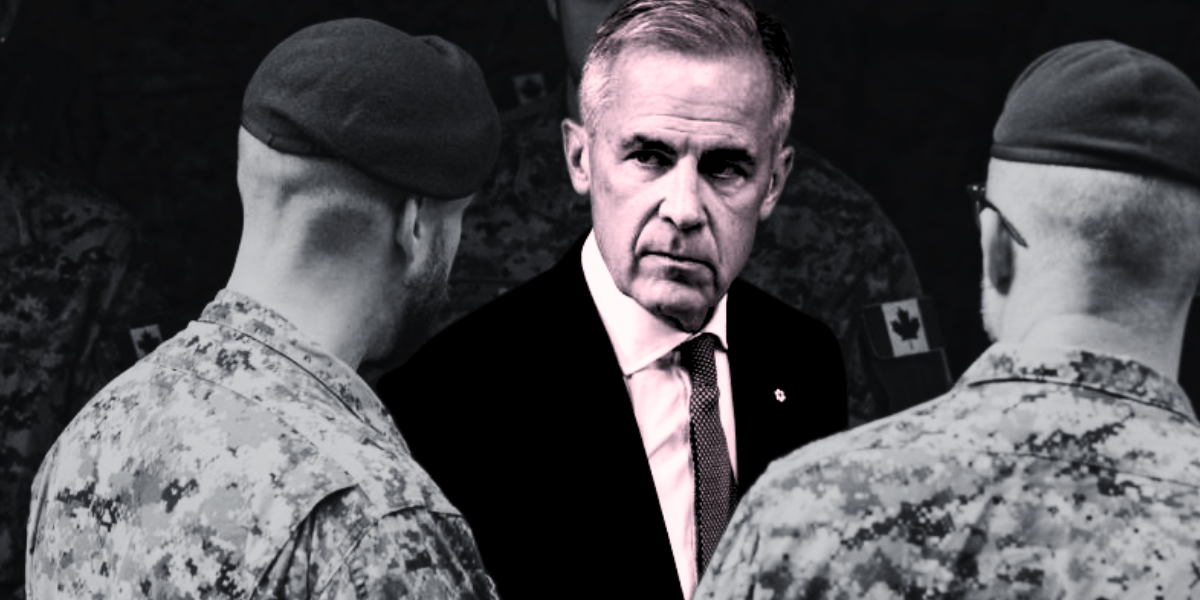
Mark Carney has risen in popularity by taking on the role of Canada’s white knight: the one who protects Canada from the US threat. This has afforded him the leverage to increase military spending drastically. Wrapped in an anti-Trump narrative, Carney is looking to stimulate an economy negatively affected by tariffs and the fallout from the war with Iran through military spending. Not only will this not provide the protection that Canadians pine for, but it will also fail to buoy the Canadian economy.
Current military spending
Carney is an establishment figure who represents elite institutions and central banks, so it is no surprise that he has put forward strategies used in the United Kingdom and France. This is clear with his prioritization of military spending. In 2024, both the United Kingdom and France increased their military budgets by 2.8% and 6.1%, respectively. This equated to just over 2% of Gross Domestic Product (GDP): 2.3% for the British and 2.1% for the French. Similar numbers were observed among the other leaders in military spending, with Saudi Arabia and India increasing budgets by the smallest margins, just shy of 2%, and Israel increasing its military budget by 65%. This trend has only increased as of 2026. For the British, the total military budget is now 2.5% of GDP, around $85 billion. Macron’s government increased its military expenditure to reach 2.2% of GDP, for a total of $69.5 billion. In both cases, this equates to approximately 5% increase compared to the prior year. Carney has more aspirations, as Canada’s military spending was lower than both countries and is now set to 5% of GDP in the coming years.
The excuses for this increased expenditure vary across the political spectrum: from being the result of global tensions to the positive effect that defence spending has on technological innovation. Obviously, these factors play a role. Yet, these arguments dilute the positive effect that increased military spending has on the economy and the survival of capitalism.
Military spending and growth
Military strength is fundamental to the growth of capitalism. It is easier to understand how, in the earlier stages of capitalism, this was a primary tool for accumulation. Yet this also applies to navigating crises by stinting the falling rate of profit. Chris Harman explained how increased military spending affected several national economies in the aftermath of WWII. In essence, the state can take over the use of surplus value and invest it in military expenditures, primarily arms production. The Canadian Global Affairs Institute explained that every dollar spent on defence multiplied capital expenditures twice over. This benefits both the state and capitalists by allowing operations to continue without interruption while injecting funds into the national economy.
Mariana Mazzucato provides a worthwhile example of what Chris Harman explains: public spending, such as research and development, results in touchscreen technology and the development of global positioning technology, used for GPS. These derivatives are sold at a profit by companies like Apple. This has proliferated further with financial capital. Now, simple speculation can help the economy by boosting the stock market and improving stock valuations, resulting from positive speculation driven by capital expenditure.
As further crises have arisen, many nations have prioritized financial capital. This has resulted in a greater reliance on direct transfers to private military companies. Although this problem is not isolated to military expenditures, it creates our current scenario where companies and their shareholders are benefiting from taxpayers, without direct benefit to the working class. This is the key distinction that leaders today either do not acknowledge or choose not to. Defence spending was greater in the post-war years, as a percentage of GDP, yet this was also the same time when those same nations increased spending on the tentpoles of the social safety net. This is no longer the case. Although social spending is higher now, it is either stagnant or in decline. Where it could once be said that military spending was increasing in line with other programs, the current moment is one in which governments look to the International Monetary Fund (IMF) model: restructure debt by offering to offset increased military spending through cuts to the social safety net.
Oh, Canada, we stand on guard for thee
When it came time to announce his first budget in November 2025, the key takeaways were that the federal government would increase the military budget to 2% of GDP, with an increase to $81.8 Billion within five years. This does not include the plan to increase the budget to 5% of GDP by 2035. In the months following the announcement, Carney has been quick to announce several strategic priorities, stemming from the budget document Canada: Build Strong. These priorities include allocating $30 Billion to the Canadian Armed Forces (CAF), creating the Defence Investment Agency, and investing in the Defence Industrial Strategy (DIS). Carney’s plan is edified in thinking framed by a bygone era.
The issues with this plan are both economic and political. First, the government’s objective is to increase its fighting capacity by increasing its paid military personnel by 15,000 and its reserve forces to 100,000. Included is the hope of adding 300,000 volunteers. At the time of writing, the CAF has 68,000 active personnel and 27,500 reserves, with no sign of a large swath of recruits. The lack of recruiting has led to talks of implementing a volunteer brigade to improve these numbers. Considering so many funds were allocated to the CAF, it seems odd to rely so heavily on volunteers. Relying on citizens to partake in defence can be dependable; Cuba provides an important example. However, this does not require greater investment in military spending–certainly not with the ambition Carney has displayed. Rather, Cuba’s military budget has remained stagnant, approximately 2.9% of GDP, since 2017, despite increased US economic aggression since Trump’s first term.
Second, the $82 Billion allocated to the military will not improve the situation for working-class Canadians. Even in cases where it could be argued that funds will circulate into the economy, like the $40 Billion allocated to expanding northern defence capabilities, this will be offset by cutting 40,000 federal jobs, along with all the jobs lost due to additional consequences. There is also no guarantee that these jobs will benefit Canadian workers. Moreover, Canada’s present arms manufacturing capabilities rely heavily on the US. This is evident in the recent contract with Colt Canada. Over the next three years, this is supposed to cost $307 Million in contracts. However, this can all be undone by US interference, given that Colt Canada relies on American licenses. It seems that if the objective is to move away from the United States and stimulate the economy, why not focus on industries that are less dependent on the US?
There will undoubtedly be some benefits from this allocation of funds, but Canadian workers will not see these benefits. Carney’s budget demonstrated a focus on private investment. This priority is emphasized in the military strategy as well. With this, financial capital is the primary focus. This will infect that economy more generally, but in ways that advantage those with diversified stock portfolios rather than those who rely primarily on their income to get by. This is evidenced by Colt Canada’s stock performance as of March 17, 2026, which rose by approximately $9 per share the day after the announcement. AI offers another premium example. Both the November budget and Carney’s military spending priorities focus heavily on “modernization”, which means a greater reliance on AI to provide general services. The Canadian Centre for Policy Alternatives reported on the nexus between data centres and US military bases. This might be a troubling thought to most, yet Carney’s plan shows that his only objection is that the data centres be Canadian military bases. Military economies do not trickle down in the ways that Carney is promoting. This is not the same model that William Lyon Mackenzie King inherited following WWII. That was only possible because of the global impact of that war, shaking capitalism out of the crisis that led to the Great Depression. Without a war of that magnitude, this is likely to fail, leaving people in the unenviable position of relying on a cataclysmic war to keep capitalism moving. An anti-war option is necessary and possible to avoid this deterioration.
Author

Did you like this article? Help us produce more like it by donating $1, $2, or $5. Donate