
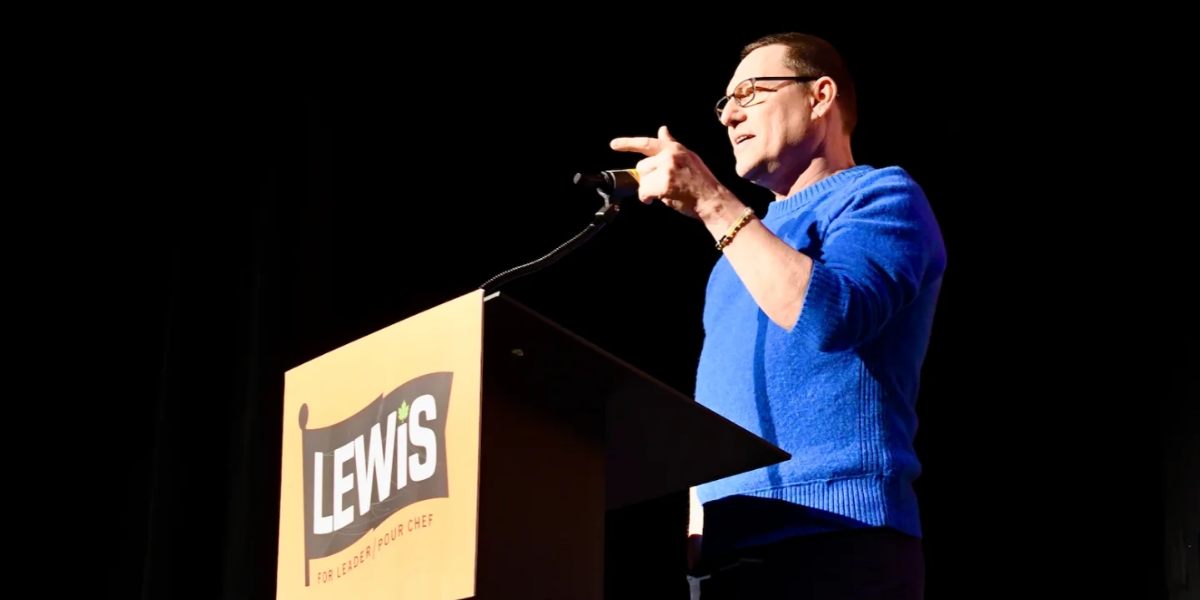
Avi Lewis’ victory in the NDP leadership race in March was decisive. His win is a breath of fresh air in a political landscape that has moved well to the right over the last number of years. In the midst of an increasingly volatile world, socialists have to figure out how to orient towards the NDP under Lewis in a way that can seize on this moment to deepen the confidence and capacity of the working class to fight for a better world. To do this we have to understand why Lewis won, the state of the current NDP, the trade union movement, and the broader Left.
What led to Lewis’ victory
Lewis won on the first ballot of the leadership race with 56 percent of the vote. Throughout the contest he dominated fundraising efforts. And he did this all while running on strong social democratic politics.
The overall leadership contest also demonstrated weakness within the party and its ability to draw new people into the fold. Only one candidate had ever held an elected seat at the provincial and federal level. None of the candidates spoke the level of French required to seriously contend as a national political figure. From the beginning there were really only two viable candidates — Avi Lewis and Heather McPherson. Lewis’ politics and his ability to clearly communicate gave him a real leg up. The team around Lewis put together a broad base of volunteers for its campaign, community events, and one-on-one outreach.
Lewis campaigned on clear social-democratic promises such as public grocery stores, funding for free public transit, reforming Employment Insurance, expansion of public healthcare, more funds for public housing, climate justice, and the introduction of a (small) wealth tax. His campaign was refreshingly clear and confident in articulating a class based message. His victory on the basis of these politics was a defeat for the more centrist approach inside the NDP and in the trade union movement.
A party in crisis
While Lewis’ victory was decisive we should be under no illusions about the state of the party and the broader left in Canada. The absolute weakness of the federal NDP and the trade union movement allowed Lewis to cakewalk to victory.
The last federal election left the NDP as a rump party. It achieved its lowest vote share and seat count in the 93 year history of the CCF/NDP. It lost a whopping 1.8 million votes, representing a decrease of 58 percent of votes from the previous election. Last year’s federal election saw it lose scores of traditionally safe seats to the Liberals. It now has no seats east of Winnipeg.
The total party membership of the NDP after the convention is much lower than the previous two leadership election contests (25 percent to 30 percent fewer members — but higher voter turnout than the last two elections). 39,000 (56%) people voted for Lewis in the leadership race, which is both impressive and sobering. To give a sense of scale, the insurgent Jermery Corbyn’s UK Labor leadership bid in 2015 garnered 250,000 votes. Factoring differences in population, this is 124 percent more than Lewis. Recent polling shows Lewis remains a marginal political figure in national politics. Lewis’ favourability numbers show a consistent net negative. He is mostly unknown, according to a Pollara poll in early July only 12 percent of Canadians can even name Lewis as NDP leader. This reflects the relatively marginal position the federal NDP finds itself in politically and lays out the urgent work that needs to happen to bring in new people into the social democratic vision laid out by Lewis and team.
At the same time, the federal NDP is in a massive financial hole. The federal party has between 10 to 15 million dollars in debt. While Lewis raised an impressive amount of cash, the leadership race barely put a dent in the party’s leaky financial situation. It is alarming how concentrated his donor base was in the richer downtown urban ridings. This is part of a broader trend of the NDP’s shifting voting and donor base at the provincial and federal level. It also reflects a more sweeping class realignment of social democratic parties around the world. The voting bases of these parties are trending richer, more educated, more urban, and more professional than previously.
NDP and the labour movement
The NDP that Lewis is inheriting is a party that is riven by major debates over climate policy, industrial development and the role of public services. Provincial sections in Manitoba and B.C. are in government and they are governing well to the right of where Lewis is. Both Manitoba Premier Wab Kinew and BC Premier David Eby are pursuing pro-oil and gas policies. And the provincial sections in Alberta and Saskatchewan are even more rightwing on these and other issues. Thus, it was no surprise that almost immediately Lewis’ leadership came under attack from the Saskatchewan and Alberta leaders. Lewis will have to figure out how to navigate these differences and the current approach of agreeing to disagree is untenable.
While Avi Lewis was able to win some union endorsements, most notably CUPE Ontario, it was clear a large section of the trade union bureaucracy was backing the President of ILWU, Rob Ashton’s leadership bid. It turns out this support had about as much force as piss in a hurricane. The inability of the trade union leadership to translate their political position into votes is symptomatic of the weakness that resides at the top of our labour movement. Leadership and the broader bureaucracy is lacking a real connection with rank-and-file members in their own unions, have a shallow level of politics, a limited understanding of how change happens, and no sense of how to organize broader sentiments within the working class.
While it is not a bad thing that trade union leaders simply can’t impose their will on the NDP leadership race, it is disconcerting to see a growing disconnect between union membership and the NDP. The NDP’s historic ties to the Canadian Labour Congress (CLC) have helped it maintain itself as a distinct working class party. Despite its weaknesses, the NDP does represent a voice for the working class in Canada. Without repairing its institutional and historical grounding in labour, there is a real danger the NDP could, in the long-term, lose its direct ties to the working class by transforming into a hodge podge collection of ‘radical’ do-gooders. This would be a blow to working-class politics.
Lewis will undoubtedly encounter major resistance from trade union layers over his more radical sounding reforms. A socialist leader does not translate to the wider working class automatically supporting more robust social democratic demands — let alone socialism. These ideas have to be tested and won locally at workplaces, and anyone organizing in their unions knows the resistance in the face of such efforts. In the absence of doing the urgent groundwork of engaging with the wider class to build their confidence to demand radical demands from below, there will be intense pressure on Lewis to be more practically-minded. At first this pressure will be exerted behind closed doors, but it wouldn’t be shocking if it comes out in the open if Lewis falters.
Promise and pitfalls of electoralism
Lewis’ victory should be situated within a broader current of radical social democracy that has emerged since the financial crisis in 2008. That economic shock has slowly upended politics across the globe and opened up space for a kind of social democracy not seen since the 1970s. Podemos in Spain, Syriza in Greece, Corbynism in the UK, Melenchon’s LFI in France and Bernie Sanders and the DSA in the US, despite their differences, are part of this global trend. The inability of centrist politicians to deliver meaningful alternatives to the neoliberal status quo opened up new possibilities for the left and right.
The growth of left-reformism has on the whole been positive development. A re-engagement with mass politics is an antidote to narrow and often sectarian ultra-leftism that can take hold in periods of low political struggle. But with this advance comes theoretical confusion for the socialist left over where the path to social democracy can take us.
The Left-reformist political projects contain within them (often unconsciously) a theory of social change that is top-down and substitutionist. Substitutionism relies on good demands being carried out by a few leaders and relying on top-down structures rather than democratic processes to build worker power, waiting on the right people to carry the work as opposed to believing everyone is capable of it. They articulate a road to reform that begins with and often ends with elections: “Change happens via elected officials winning office.” Thus the party form and functions are organized around the central objective of winning elections. This means fundraising, door-knocking, advertisements and rallies are done at the service of winning elections and getting the right people to elected office because elections are a pathway to government and government is the means by which reforms can be enacted.
Left-reformist parties winning elections, forming governments, and passing good legislation are not bad things. In fact, they are very good things. But it is a limited endeavor that also carries risks. From left-leaning social democratic leaders succumbing to pressures and becoming managers of capitalism to being removed by their own party ranks, we have seen how this can play out if the wider class is not engaged outside of the project. The two most high profile examples are the Democrats’ attacks on Bernie Sanders’ widely popular campaigns for the Democratic presidential nomination both in 2016 and 2020, and the British Labour Party’s attacks on Jeremy Corbyn, when he was leader. In the end, the establishment and media backers of both parties preferred handing their respective elections to the right wing because the outcome represented less of a threat to their shared interests than winning under a progressive or left-wing leader would have.
The pressure of electoralism — the view that change comes from the ballot box — structurally shapes what parties and activists within these parties do. Should we be building a strike or out door-knocking for a local candidate? Should we be out building anti-war rallies or phone banking to raise funds for the party? While this may seem like a false choice, it often isn’t. For instance, Lewis and his team released good statements about the war on Iran during the campaign, but they didn’t use their network to help organize rallies or anti-war petitioning to give expression to the sentiments in the statement. And the choice to do this was up to Lewis and his small team, not the activists around his team.
This is not a criticism of Lewis. Rather, it highlights the structural pressures a party faces when pursuing an electoralist path to social change. Should they shed more radical demands to make themselves more palatable to increasingly larger swaths of the electorate? This can’t be solved by finding pure leaders — this is a question that is ultimately about the political terrain upon which these parties fight it out.
Reform or revolution
Leaders spouting radical socialist demands do not automatically win people to socialist ideas even when the reforms are desperately needed. Instead, the inverse is true — the material conditions of struggle and the state of social movements are what give leaders the confidence and ability to articulate radical socialist demands and have them land with people. There is often unarticulated stagist assumption undergirding left reformist electoral projects. First we need to find radical pure leaders to articulate strong social democratic demands and then this will radicalize the class and spark movements.
In the socialist tradition the approach to social change through elections and the implementation of reforms as a mechanism to achieve socialism goes back to the 1800s. Sometimes called evolutionary socialism, reformism, Lassallism or step-at-a-time socialism. This perspective rejected a revolutionary road to socialism as either unnecessary or impossible. This was always presented as a practical and rational approach and seen as the right wing of socialism. Given the state of the movements and the weakened socialist tradition, these ideas have found new life as radical and hopeful.
While many of these projects talk about the need for social movements and elections, including the Lewis campaign, in practice, movements are treated as corollary to the central project of winning state power through elections. In these projects, leadership (the people making tactical and strategic decisions) is still concentrated around the parliamentary centre. Even where independent organizations arise in the wake of electoral breakthroughs, such as Momentum in the UK, they often remain appendages of an electoral strategy (in the case of Momentum, its leadership became anti-Corbyn). Some on the left believe all that is needed is to replicate a Momentum-style organization to bridge the gap between movement and party. The problem with this argument is that it does not address the basic question of why Momentum failed as a political project. The recent revival of Courage, a loose ginger group of socialists around the NDP formed in 2017, hopes to play that role — this time around Lewis. Can Courage be a semi-independent vehicle to pressure the NDP and Lewis to go Left? There are reasons to be doubtful. For one, there has been no real accounting for why Courage originally folded. Without learning from the previous experience, it is hard to be optimistic about its revival today. Secondly, this new iteration is even more explicitly tied up with the Lewis project and the NDP than its original formation. Perhaps it can group together Lewis supporters, but without a clear purpose and organizational form, is unlikely to be able to assert independent pressure or survive in the long-term.
In Canada, the Left has lots of experience to draw from in this regard. When the CCF (the forerunners to the NDP) was formed in 1932, it saw itself as both a movement and a party. However, this dualism of being a party of protest and the ballot box did not last; fairly quickly the pull of electoralism shaped the form and practice of the party. All of the functions of the party came to serve the project of competing in elections. Rather than being a megaphone of the movements, movements were seen as serving the party’s electoral fortunes.
This doesn’t even begin to address the real challenges that await left-reformist political projects — winning elections. If left-reformism actually achieves government, what will it do? Is it prepared to confront the power of the capital? Capitalists continuously exert their power via extra-parliamentary means. Are parties that see elections as vehicles for major social reforms equipped to meet these challenges?
And what if these projects are defeated? While Lewis’ victory raises expectations, we have seen time and again how over the course of the last ten years these efforts have come crashing down, leaving many demoralized.
How should socialists relate to the NDP under Lewis?
Learning from our own history and other international experiences of left reformism we offer three starting points about how we can orient ourselves to the NDP under Lewis.
First, we can’t wait for the Lewis project to act. While 39,000 people voted for Lewis, this number does not represent its actual organizational capacity. Most who voted in the leadership contest are inactive in the party. A recent email went out to party members outlining intended organizational changes in the party: the creation of more Councils of Electoral District Associations, investing in more internal education and encouraging monthly dues. But Lewis’ promise of the creation of organizing hubs at the riding level remains a vague gesture at this point. The left can’t wait for these formations to begin to organize.
Second, we need to find a way to relate to the people who voted for Lewis or who feel a renewed sense of hope because of his leadership victory. Lewis has been touring the country and drawing decently-sized crowds. Some of these meetings have organizing components such as break out sessions. We should be there, listening to people and providing practical suggestions to draw people into activity. While there is still a big emphasis at these events on canvassing and door knocking for elections, there is an appetite to do more than just get people elected and keep them in power. The renewed hope in the NDP and Lewis tells us that people want change and are prepared to fight for it. We have to lay out a path and program that goes beyond the parliamentary project.
Third, we need to use Lewis’ politics to advance left politics inside trade unions. The state of union politics is grim. It was heartening to see Lewis go to the CLC Convention and be a visible supporter of Palestine. This is a direct challenge to right-wing labour leaders. The NDP under Lewis has the potential to push the labour movement politically leftward, to be clearer about expanding public services, challenging military spending, supporting peace, and taxing the rich. But this can’t happen via Lewis alone. The NDP has no organized mechanism from below to drive these politics into the union movement, especially when labour leaders are increasingly disconnected from its own membership. It is at the workplace and community level that these politics matter. This is a role that organized socialists can play.
In Spring we can do our part to help connect and organize people excited by Lewis’ ideas and give them the confidence to organize on the issues in their workplaces and at the local union level beyond the electoral project. It is an opportunity to do the patient, long term, and rewarding work of bringing new people into the struggle who may or may not be on board with Lewis or even the NDP but could be won over to advance the radical demands that benefit everyone. This means doing our part to build broad-based United Front campaigns that help advance the interests of the broader working class, while also building the current of revolutionary socialists who are committed to advancing socialism from below.
This is an opportunity for the left
The entire left should see this as an opportunity to bolster efforts to advance working class politics. We should be open to engaging in mass politics that broadens our struggle and builds the confidence of the class to bring about change, not just our elected representatives. We should aim to connect with his supporters on the basis of political action — making the case for building bigger movements. We can’t rely on team Lewis to give the lead for everything or change the political terrain working against us. A real weakness in left social democratic political projects in the modern era is an over reliance on formal leadership followed by demoralization when the leadership fails to deliver us the change we want. A successful electoral strategy for the left must see the self-organisation of working people as the core of our power, and elected representatives as their servants not their masters.
There will be lots of twists and turns. Lewis will face a hostile media, a slew of internal barriers and challenging conditions. We should be looking to use this moment to advance socialist consciousness where we are rooted and increase the ranks of the left that want to get in the trenches to fight for a better world.
Authors


Did you like this article? Help us produce more like it by donating $1, $2, or $5. Donate