
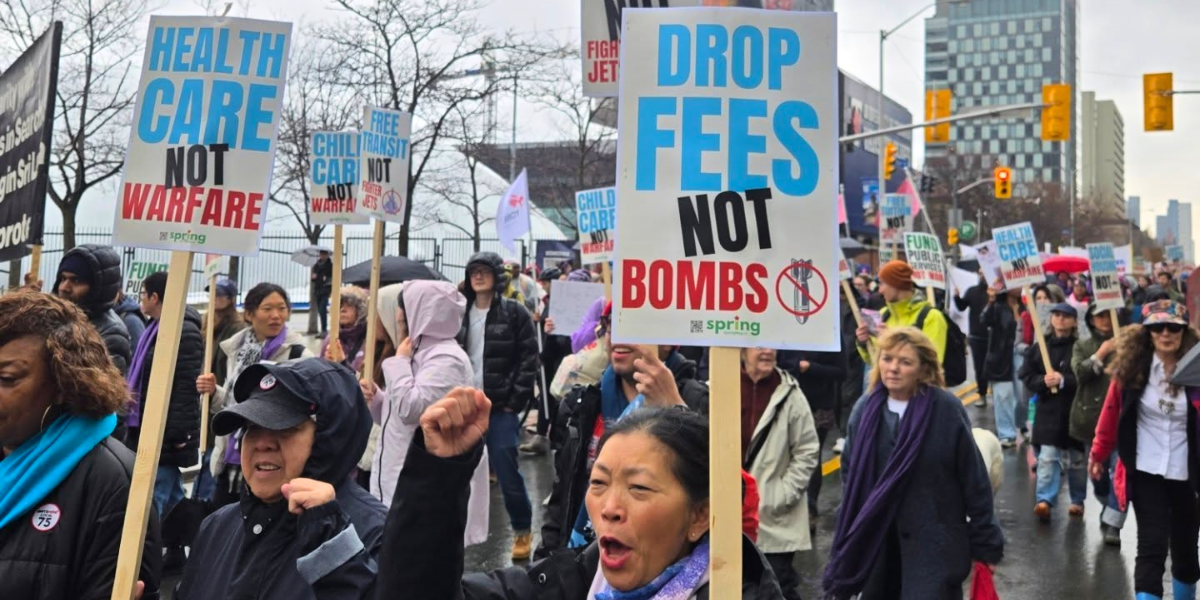
The 2020s have seen a dramatic rise in armed conflicts around the globe: the genocide in Gaza, the ongoing invasion of Ukraine, the attacks on Lebanon, Iran, and Yemen, the bombings of the UAE, Saudi Arabia, Iraq, Qatar, Kuwait, Bahrain, Oman, the attack on Venezuela, the continued devastation of the wars in Sudan, Myanmar, and the Congo, as well as the recent conflict on the Afghanistan and Pakistan border.
This uptick in violence and war is not an aberration but a trend. The massive surge in military spending across the globe paints a bleak picture of the future where, increasingly, states feel more willing to use brute force to advance their political interests.
To counter this, we need to build a broad-based movement against war and militarism. So how should socialists go about this?
Theoretical clarity
The first thing we need is clarity about understanding why capitalism breeds war and why the working class has both the power and the interest in opposing our governments’ drive to war.
As Marxists, we understand imperialism is a system of inter-capitalist competition between rival states over control of resources and for the domination and exploitation of working people and the poor. This rivalry between states is not equal and it does not always take the form of violent conflict. It also exists alongside cooperation between states. This is because imperialism is an expression of the horizontal competition between capital projected onto the international stage through states. The current war on Iran by the U.S./Israel is not just being waged on the military front but also on the economic front — increasing energy prices and squeezing the gears of capitalism.
Wars are fought between states (and quasi-state actors). Our job as socialists is not to cheerlead for any state but to unite the global working class in a project of liberation. Concretely this means building workers’ confidence to oppose wars and militarism of their own state. Focusing on our own ruling classes’ support for war in militarism is done for two basic reasons.
First, because it is what we can impact. When our ruling class beats the drums of war, it does so in the national interest. Workers have real material power and leverage to resist this vis-à-vis their own state in a way we do not have vis-à-vis other states.
Second, because it is in the interest of our own class to oppose war and militarism. Every dollar that is spent on fighter jets is one that is not spent on hospitals, child care, or education. Despite the appeals of nationalism, the vast majority of workers’ lives in Canada would be improved if we redirected money earmarked for war into public services.
Distinguishing between analysis and agitation
While having a sharp analysis of capitalism and imperialism is a must for socialists, confusing analysis with agitation presents a real danger to building a movement. Our actions need to be theoretically informed, but also speak to a broad audience in a way that invites them into a movement.
We can not build a broad-based anti-war movement by speaking to people as if they are already socialists. We must distinguish between analysis and agitation. The kinds of slogans and propaganda we utilize should be speaking to people to our right — not our left. If our goal is to be seen as the most radical and left-wing, our slogans would feature words like “imperialism” and “monopoly capitalism.” If our goal is to build a force capable of pressuring our government to oppose war and militarism, we would lead with slogans like “child care not warfare.”
Transforming passive agreement into active support
Most people in Canada, especially workers, oppose war. The U.S./Israel bombing of Iran is deeply unpopular in Canada — despite the fact that our Prime Minister has voiced support for it. But this sentiment remains extremely passive. If the only thing people are asked to do is come out to an endless series of emergency demonstrations at high leverage moments, there is a high chance that participation will shrink and people will feel demoralized.
Our job is to find a way to get people to feel confident to act on their anti-war sentiment. This means providing a lead toward accessible and easy actions with a clear message. Organizing phone zaps and letter writing to Members of Parliament. Going out to community events or rallies and getting people to sign a petition opposing the war. Delivering those petitions to their local MP. Texting, phoning and emailing, people who sign these petitions inviting them to rallies or other anti-war actions. Getting people to put posters opposing war in their neighbourhood or wear anti-war buttons. Giving people the tools and confidence to raise this issue in their local faith community or community group.
Our goal is to popularize an anti-war sentiment. We want to invite people into our movement to build their confidence and deepen their politics. We can only win if we build a mass movement.
Make this a class project
The most organized section of the working class is the trade union movement. They have the most potential power and the best resourced class-based institutions in the country. If we are going to build a mass movement against war and militarism in Canada, we have to be able to win unions over to this project.
This doesn’t simply mean getting union leadership to articulate an anti-war position (of course we want that too!). If we want to advance an anti-war perspective amongst the working class, we have to go beyond an approach of getting union leaders to pass paper statements into a project that seeks to move union members into action. This has to be a bottom-up project.
This is not something that can be done from the outside. Unions are democratic organizations. Networks of trade unionists with an anti-war perspective need to talk to their coworkers and fellow trade unionists. Get them to sign petitions, talk to them about issues in their lives and the connections this has with increased military spending. Trade unionists with real roots in their local or labour council should be raising this issue at local meetings or aiming to pass resolutions. Tactically this should be an undertaking carried out by people who have established real roots in their union.
Currently, leaders and rank-and-file trade union activists who may share our opinion about the war and militarism do not feel confident to argue that our unions should make those links between cuts to public funding and increased militarism. If unions are going to go beyond making anti-war statements, we need to lay the ground for union leadership at all levels to feel confident that their members support a project organizing against war.
When workers are organized at the shop floor level, they can actually begin to assert their power in the workplace. They have the power, as a class, to force our ruling class to change their position on a whole host of issues, including on questions of war and military spending. But this can only happen if workers themselves take action. The left cannot shut down arms production or halt transportation of military goods from outside the workplace. There is no substitute for the power of workers.
Build real United Fronts
A mass anti-war movement can’t be the purview of any single organization or even a small group of organizations. It invariably has to be a united front of a vast array of organizations with social weight — not a mere smattering of small grouplets. A united front of unions, faith groups, human rights groups, and other civil society organizations united around a limited and narrow set of demands around opposition to war and militarism is going to be necessary.
This doesn’t mean socialists and others on the left should not bring their politics into those movements. Any vibrant movement will have debates over perspectives, strategy, and tactics. It simply means socialists should aim to ensure the movement is organized with the intention of drawing in the widest possible numbers into its fold. When people are active and engaged in the movement they have the best chance to deepen their politics and build their confidence which benefits the entire left.
We are confronted with an increasingly violent and unpredictable international order. If the Left is going to transform the world it is going to require us to build mass movements that oppose war and militarism.
Author

Did you like this article? Help us produce more like it by donating $1, $2, or $5. Donate