
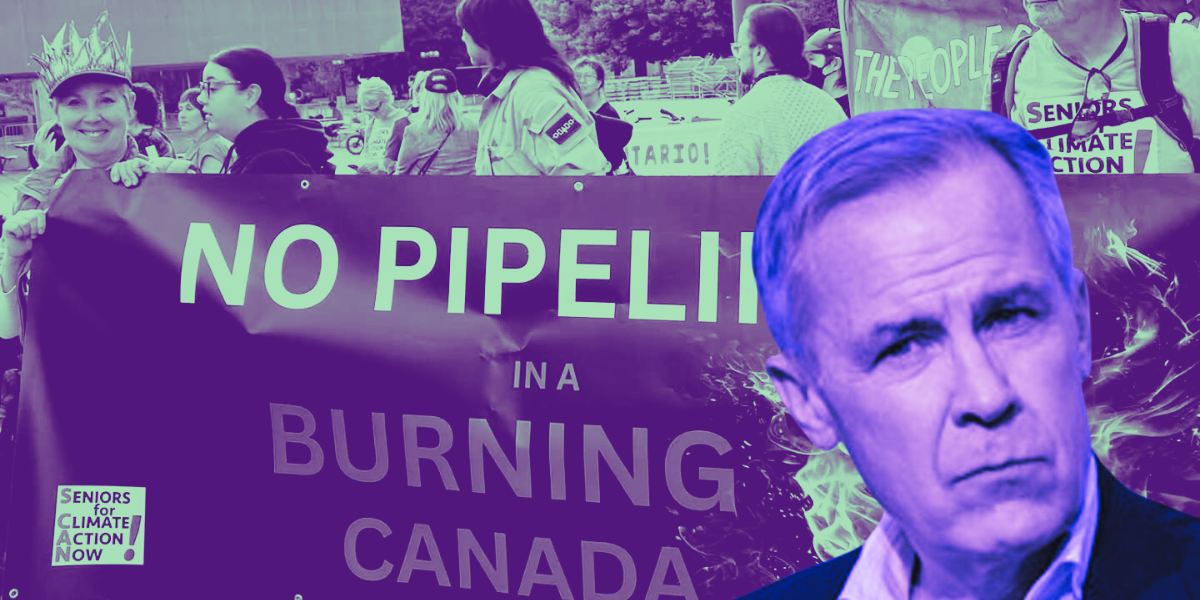
On August 17, 2026, Mark Carney announced the largest clean energy investment in North American history. The investment totals around $70 billion with $10 billion of that coming from the federal government, with funding will primarily going towards developing hydro-electric infrastructure on the east coast of Canada. Though this investment is surely a step in the right direction, it feels quite odd given the trend towards fossil fuel investment we have seen from the Prime Minister.
Carney’s political career has been shaped prominently by posturing as an advocate for the environment. In his book Values, he claims to believe that moral stances should be held over corporate profits, a stance we have seen little of during his time as PM. From the removal of the consumer carbon tax, 16 days into his leadership, to his support of the Trans Mountain Pipeline, Carney has shown himself to be a strong ally of the fossil fuels industries.
On June 30, Carney released a video explaining Canada’s so-called “energy future.” This video discusses the historic need for forward thinking, non-carbon infrastructure as well as glorifying the figures that worked towards building hydro-electric and nuclear infrastructure. The video also emphasizes the importance of oil and liquid natural gas (LNG) pipelines when it comes to the export market and claims that creating more pipeline infrastructure to bolster exports would be the best way to adapt to the current situation with a more hostile US. He announces that Canada will not be meeting climate goals as it cannot afford to restrain the growth of oil and gas production despite also claiming in this video that Canada is embracing clean energy sources.
This video perfectly illustrates Carney’s persona when addressing climate change: posture as an advocate against climate change, while only toting insignificant and unsubstantive solutions. It would appear that greenwashing is Carney’s ultimate goal — maintain the status quo, but make it appear good for the environment. Allowing him to be a strong supporter of the fossil fuel industry, while being perceived by his liberal audience as being an advocate for the environment, who makes ‘necessary compromises’ for economic development.
Even the recent investments in more environmentally friendly infrastructure are not taking the climate crisis seriously. The investments champion expensive and permanent carbon projects, all of which will still harm the environment. Carney seems to wish to present the creation of new oil and gas centered infrastructure as equally brave and innovative as the implementation of hydroelectric or nuclear infrastructure and this is simply not the case. Carney’s commitment to the aforementioned hydro-electric project is about $10 billion, which is dwarfed by the roughly $40 billion in planned federal spending on pipelines that perpetuate the reliance on carbon, as well as carrying the potential of disastrous leaks.
The $10 billion in federal money for clean energy is far from nothing, but it certainly does not foreshadow a change in broader policy approach. Since Carney has been in office we have seen the removal of the consumer carbon tax, reductions to our emission targets, as well as large amounts invested in pipelines. These policies focus on maximizing profits for oil and gas rather than addressing the climate emergency in front of us. Now is the optimal time to focus on a full energy transition.
Instead we are seeing Carney try to play catch up. A more serious attempt to make up for lost time in the fight against the climate crisis would likely avoid huge levels of fossil fuel investment. In order to minimize the effects of climate change as well as maximize Canada’s prospects for energy production, we must focus our federal policy on a future with as little carbon based energy as possible.
This new investment may be a welcome addition to Canada’s energy but this seems to be another example of Carney’s tendency towards greenwashing. Using public money to ensure private profits. These new pipelines are hardly for the sake of future proofing Canada, but merely the government gifting private industry a faster method of stripping value from the land. The path to a decarbonized Canada may be long, but the prime minister’s continued investment in permanent infrastructure remains very troubling.
Author

Did you like this article? Help us produce more like it by donating $1, $2, or $5. Donate