
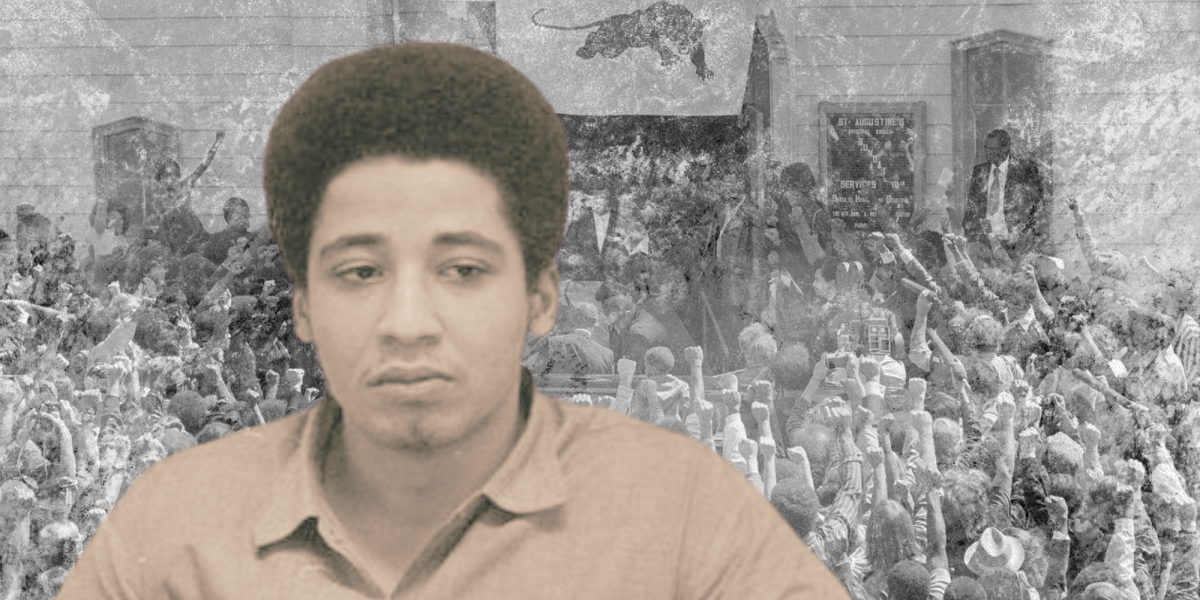
As reactionary policies become further entrenched by increasingly overt copaganda, bi-partisan support for prison expansion remains a foundational component across the electoral spectrum. Since 2020, several provinces (including NDP-run BC and Manitoba) have committed to building a combined 3800 prison beds by 2031 in both existing and newly built carceral institutions at the exorbitant cost of around $5.6 billion.
This should come as no surprise to abolitionists familiar with the role incarceration serves in upholding the white settler-colonial order, which has only gained further legitimacy under the latest liberal regime. During such critical times, it is imperative to remember the words and praxis of the Black revolutionary prisoner George Jackson.
Memorialized in many ways, Jackson primarily exists in the socialist ethos as a militant organizer within the Black Guerilla family, a cadre-run organization that operated as the prison branch of the Black Power movement. Perhaps most importantly, Jackson, like all revolutionary historical figures, should be remembered as someone whose writings and influence were shaped by his material conditions.
For Jackson, witnessing the conditions of San Quentin and Soledad state prisons in California catalyzed his understanding of fascism to extend beyond European horizons. Instead, fascism is a continuous process cemented into the everyday repression of Black people within the United States, maintained and upheld by the prison-industrial complex. If prisons are perceived as being constitutive of settler fascist power, then prisoner liberation is a necessity in building what Lenin called the united front: the unification of the collectively oppressed in the fight against fascist forces.
Comrade George
Growing up in Chicago during the 1940s and 50s, George Jackson was molded by constant racial surveillance and targeting of the state, oscillating between arrests, parole and juvenile prisons. At 18, Jackson received an indeterminate sentence from upwards to life in prison for taking $70 from a gas station. In describing his upbringing, Jackson acknowledges he was “born to a premature death, a menial, subsistence-wage worker, odd-job man, the cleaner, the caught, the man under the hatches, without bail – that’s me, the colonial victim.”
Jackson is unique among revolutionaries in that his contributions to anti-capitalist praxis arose entirely from the time he was imprisoned, which was for his entire adult life. His confinement was essential to his political consciousness: “I met Marx, Lenin, Trotsky, Engels, and Mao when I entered prison and they redeemed me. For the first four years I studied nothing but economics and military ideas.”
Before he gained national recognition for his first book Soledad Brother in 1970, George Jackson had already attained the rank of Field Marshall in the Black Panther Party (BPP). It was while imprisoned that Jackson, alongside his comrades, established a vast network of solidarity consciousness through reading.
Jackson’s organizing served as a major catalyst for rebellions against oppressors both within and outside the prison, where his story contributed immensely to the increasingly prevalent role of the political prisoner in discourses of struggle in the late 20th century. In discussing Jackson’s first book Soledad Brother, C.L.R James called it “the most remarkable political documents that have appeared inside or outside the United States since the death of Lenin.”
The 29-year old’s permeating radicalism was not only recognized by socialists but by his oppressors as well, as emulated by a quote about Jackson’s final book Blood in My Eye from L.H. Fudge, an associate superintendent of a California prison camp in the 1970s:
“This book provides remarkable insight into the personality makeup of a highly dangerous sociopath, this type of individual is not uncommon in several of our institutions. Because of his potential and the growing numbers, it is imperative that we in Corrections know as much as we can about his personality makeup and are able to correctly identify his kind … this is one of the most self-revealing and insightful books I have ever read concerning a criminal personality.”
Due to the Black radicalism that prisons ignited and continue to ignite, Jackson’s work remains one of the most banned in prisons over 50 years later. As of 2016, prisoners in California who possess material that commemorates Jackson and other political prisoners during Black August are labeled “prison gang members” and punished with indefinite solitary confinement. While the radical politics of Civil Rights icons such as Martin Luther King and Malcolm X have been whitewashed by capitalist history, it appears to be in the interests of the powerful to utterly suppress the memory of Jackson in public consciousness, in addition to punishing those who claim him as an inspiration.
In 2005, then-California governor Arnold Schwarzenegger authorized the state execution of Stanley “Tookie” Williams on the basis that he dedicated his book Life in Prison to Jackson, claiming it was a clear sign that Williams had not been reformed by the carceral system. It is integral then for us to situate the impact of such a censored figure, to understand how Jackson confronted state power by uplifting the struggles of the imprisoned in his time in an attempt to unify the colonized and subaltern masses against their oppressors. Further, we must analyze why such ruptures were perceived as a severe threat to white hegemonic capitalist power.
Prisons, fascism
The United States has the biggest prison system in the world as it serves as one of the core mechanisms to maintain the colonial empire. As Harsha Walia asserts, the Black radical tradition emphasizes fascism as a stage of colonialism, deeply embedded within the historical dispossession that defines racial relations within the United States today.
This is where George Jackson’s conception of fascism differs from western-centric understandings that prioritize European authoritarian regimes, most notably Nazi Germany and Mussolini’s Italy, as the embodiment of fascism. According to Alberto Toscano’s book Late Fascism, the contributions of both Jackson and Angela Davis challenge this ideology by framing fascism not as a monstrous aberration to democratic liberalism but as an already existing double, continuously reproduced in response to revolutionary consciousness that threatens the capitalist order. In this sense, fascism for Jackson is not a breakdown of democracy. Rather, it is a form of restoration of the status quo in order for the state to combat such rising consciousness.
The way fascism manifests itself in this restorative operation is through the construction of race, which divides the working class to compromise solidarity, and the maintenance of exclusion zones such as reservations, segregated city areas and prisons to target racialized populations perceived as perpetual dangers to white supremacy. For Jackson, fascism then is not a looming, static threat defined by traits from a check list but a process, a counter-revolutionary reaction that has permeated itself within the United States ethos since its founding. The question arises: how does our organizing change if we understand fascism not as a foreboding but as a built in component of the settler colonial state in crisis?
United through prisoner liberation
A common debate among socialist circles is whether to prioritize the struggles of the most oppressed, such as incarcerated people, or the struggles of organized workers in unions who are materially better advantaged. For Jackson, the emancipation of the former is what he devoted his life towards, having no other choice. Jackson was forced to endure the most egregious conditions of state violence, in which he connected his lived experience with theory to recognize prisoner liberation as the impetus of furthering socialist consciousness. In the words of Walter Rodney, Jackson served as the “vanguard of the most dangerous front of struggle.”
Prisoners in the Marxist tradition have often been reduced as the lumpenproletariat, a permanent underclass exhibiting little possibility for revolutionary potential. Such assertions have long been challenged by the likes of the Black Panther Party and prison organizers such as Jackson, in addition to a long line of Black radical tradition based in organizing in solidarity with those Marx considered the non-productive stratum of society. Frantz Fanon shared similar sentiments to Jackson in not only recognizing the revolutionary potential of the lumpenproletariat but arguing that they serve a leading role in the struggle against decolonization.
One only has to recognize the impact of the most influential prison rebellion in the 20th century United States to understand the collective power of prisoners. The 1971 Attica Rebellion disrupted the colonial order by establishing a Black commune within the Attica prison, where prisoners created a form of what Orisanmi Burton calls “abolitionist worldmaking.” For just under four days, the rebels of Attica held control of the prison and conducted elections to democratically create a space premised in values of collective liberation and abolition.
The Attica revolt, alongside the emerging Black power movement, catalyzed a wave of anti-carceral resistance across the United States and Canada throughout the 1970s, coalescing into an expansive rise of political consciousness among prisoners confined by the state. Rebellions inside prisons increased exponentially with more and more demands rooted in the dismantling of the carceral system. International solidarity from Vietnam, Cuba, China and North Korea further ignited the connection between prisoner liberation and decolonial struggles.
In response to the upsurge in radical rebellions behind bars, the United States invested billions following the 1970s in expanding prison capacity, implementing a variety of counterinsurgent mechanisms inside to eradicate revolutionary consciousness. Under the pretense of “fighting” drugs, the Reagan administration severely escalated the use of maximum and supermaximum prisons as a continuum of anti-Blackness that isolated political prisoners from one another, entrenching solitary confinement as a standard practice. Organizing inside became nearly impossible due to increased programmification that surveilled “problematic” prisoners, the banning of revolutionary materials and minimal reforms that improved life inside while simultaneously pacifying prisoners into obedience.
George Jackson saw through the veil of the prison to understand its role in suppressing organized efforts against their legitimacy. It was because of this that he believed prisoners to not only be a part of, but leaders in the united front against fascism. Over 50 years after his state sanctioned murder, his writings transcend time and resonate with the material conditions we are facing today in the fight for prison liberation.
Author

Did you like this article? Help us produce more like it by donating $1, $2, or $5. Donate