Elise Thorburn is an emergency physician and an organizer in St. John’s, NL. She grounds her practice in anti-imperialist Marxist politics, and operates within a framework of solidarity. She co-founded Palestine Action YYT and continues to expand its work through the Apartheid Free Communities campaign. Spring’s Robyn Letson spoke with Elise about her recent time in Gaza as well as about what it has been like to build the Palestine solidarity movement in St. John’s.
Can you begin by sharing about your recent trip to Gaza as a healthcare worker?
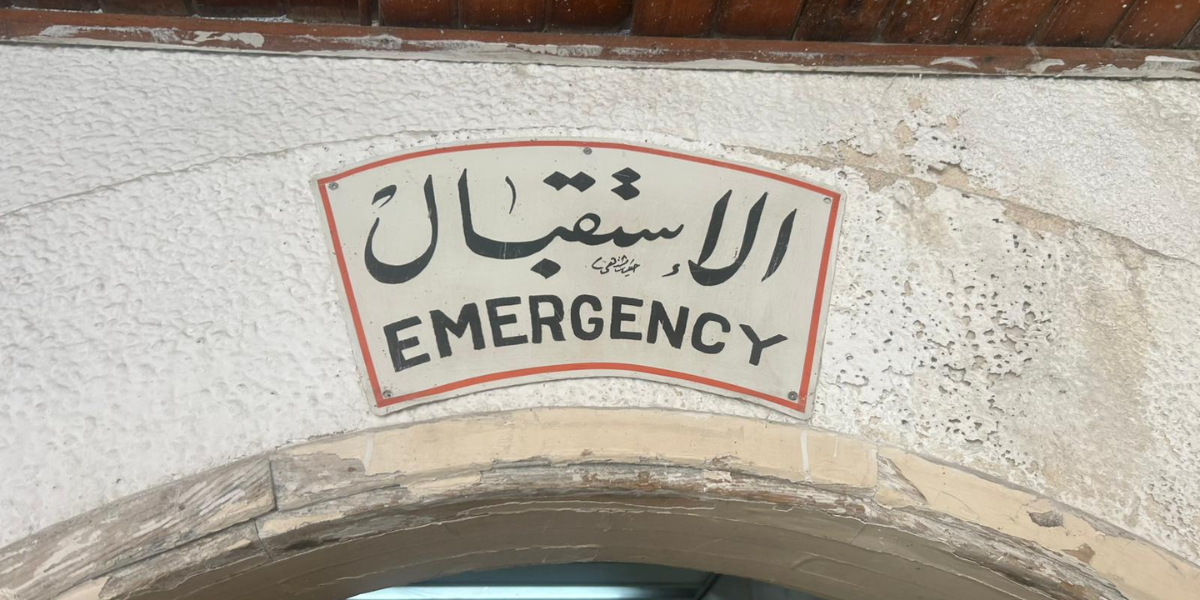
I went to Gaza in October and November 2025 as an emergency physician with Glia. I was stationed at Al-Ali Arab Hospital in Gaza City. It was the first hospital Israel bombed, on October 17, 2023. Over 400 people were murdered in the courtyard. It’s been bombed multiple times since then, including in April of 2025 when the Emergency Department was destroyed. It has operated out of tents since then.
I was there during the so-called ceasefire, which only meant that mass casualty events were less frequent, but they still happened, along with more isolated incidents of drone attacks, gunshots, or shrapnel injuries from occupation forces.
I saw my trip not as a form of charity, but rather as a form of solidarity — with Palestine and with the broader anti-colonial and anti-imperial struggle. I saw it as part of building an international network of solidarity between Newfoundland and Gaza, both sites of genocide and colonization, and of supporting Palestinian’s resistance to genocide. Both the genocide by Israel and Palestinian resistance to it is fought on the terrain of health. Israel makes use of health and healthcare to meet its genocidal ends, and Palestinians resist through their ongoing health sovereignty.
I wanted to go to Gaza with Glia because their project is precisely about building health sovereignty. For example, a big part of Glia’s work is 3D printing essential supplies that are difficult to access. While I was there, Glia began to trial external fixation devices for people with long limb bone fractures. These devices are typically metallic, so component parts can be hard to access inside of Gaza because of the siege. Glia found a way to 3D-print essential elements of the devices, which makes them more accessible because they are designed and printed within Gaza using recycled plastics.
In this spirit, it was important for me to see my role as not just going to provide clinical care but to help do what I could to build resiliency within the system.
What did practicing health solidarity look like while you were there?
First, to humble myself. To go in not as a medical expert, but as a comrade in struggle. I was there to stand alongside the patients and healthcare workers resisting their own erasure, to listen to them, to take the lead from them, to serve them. With the ceasefire there was a little more time to sit, have tea, talk. So, often, I’d just sit quietly with people while they told me about the worst thing that ever happened to them. Listening to the stories from people was as important as providing medical care, because the worst thing that could ever happen to a human being has happened to every person in Gaza multiple times over.
My time there also hammered home how politicised healthcare is. In medical training, we are constantly taught about the “social determinants of health,” but this teaching is largely divorced from any of the dynamics of power under capitalism and imperialism. In reality every aspect of an individual’s health, and “unhealth,” is a product of the political decisions being made around them. Nothing about providing medical care in Gaza is at all separable from Israel’s occupation, and resisting that occupation is at least partially about developing health sovereignty.
For example, per the occupation authorities you’re not allowed to bring in any medical supplies to Gaza. This includes a stethoscope, which is absurd. And the UN enforces this by reminding you of the limitations on what you can bring with you at the pre-entry briefing.
When even the UN does not publicly push back, colonial arrogance that manifests itself in small ways — like not allowing physicians to bring in a stethoscope — expands to make it possible to enact genocidal violence, like bombing hospitals for two years straight and denying the entry of aid with zero accountability.
This is connected to very valid critiques about international medical work. I tried, in the ways that I could, to make my trip a form of strategic resistance. The occupation forces might have thought I was just there as an act of charity, but I was using my time in Gaza to deepen and develop my political commitments and those of my community. One of my comrades in St. John’s said to me: the occupation wouldn’t let you bring in a stethoscope, but they didn’t realize you’d smuggled your whole community in with you.
What has it been like to return home to Newfoundland and share your experiences?
I do think that making connections tangible in faraway places inspires people to take action. That’s what I’ve witnessed coming back to St. John’s. Two people here went on the Sumud Flotilla and then I went to Gaza. Bringing our accounts and analysis back to our community has brought more people into the struggle by showing the connections between us and people in Palestine.
For example, I can talk to people here about the loss of the fishery in Gaza, and they can relate it to the loss of the fishery here in Newfoundland after the moratorium in 1992. The trauma that the loss of those lifeways and livelihoods bring to a community — not only financially but also socially and culturally — people here understand that. To be able to make those connections of shared struggle over something as concrete and culturally important as fishing means that we are building relations across long distances and seeing the enemy we share in common: capitalism, colonialism and imperialism. This resonates with people here and brings them into struggle rather than pushing people apart or making them feel disconnected and helpless.
Can you tell us more about Palestine Action YYT and what you’ve achieved so far?
Palestine solidarity activism has been happening in St. John’s for a long time, but it wasn’t until October 2023 that a more coordinated form of organizing started to develop here.
We started out by organizing a lone vigil. And from there we have built a strong and multifaceted movement over the past two and a half years. There’s a Queers for Palestine group, a Students for Palestine group, and a Labour for Palestine chapter.
A lot has been won by our movement: Pride St. John’s signed on to BDS and invited us to be the grand marshals of the parade in 2024. The city of St. John’s and the town of Portugal Cove-St. Philips have both signed an arms embargo statement. These victories are so far small and ephemeral but they are launch points for more concrete demands.
In terms of successes with labour solidarity, at the Atlantic Federation of Labour Conference in the fall, the Newfoundland and Labrador Federation of Labour brought forward an arms embargo and hot cargo motion and it passed. The push came from CUPW. Members of our group did visits to their picket line during their strike and built relationships. When union leadership reached out and asked if they could donate money to our organization, our response was: “We don’t want your money. Organize with your workers, push for hot cargo.” And so they did. Instead of giving us gifts, they did the work. And we are committed now to building those networks. There is now a functional Labour for Palestine project in town and a Hot Cargo townhall happening this spring.
So I think, you know, you can see solidarity on a bigger scale, like going to Gaza, or you can see it in the small acts of going to the CUPW picket line. It’s not about being transactional but understanding that we share a common goal, and about standing arm in arm against our common enemy.
What is your organization focused on for the year ahead?
Two-plus years into this genocide, I think there are real questions around how we sustain solidarity movements and continue to grow so that it isn’t the same small group of folks.
We’ve decided to launch an Apartheid-Free Communities campaign, which is an international project with networks across the country. I see it as a way of mapping the terrain of our community, finding out where our allies are and getting many more people involved. This is also a way to support the hot cargo campaign when many of us aren’t union members. Through the Apartheid-Free Communities campaign, we can ask unions to sign on and then work collaboratively with them from outside. So it may not seem like the most radical action, but it’s training us in the skills necessary to understand our terrain, develop our networks, and materially organize ourselves and others.
I think that’s how you build revolutionary change: by giving people the skills to organize themselves, their neighbourhoods, and their workplaces and give them that experience of “I can do something. I can elicit change instead of watching the news and feeling bad.” I want to use this campaign to build up people’s capacities to organize. And then from there, it doesn’t have to just be about Palestine anymore. It will be about everything. That’s my hope.
Author
Did you like this article? Help us produce more like it by donating $1, $2, or $5. Donate