
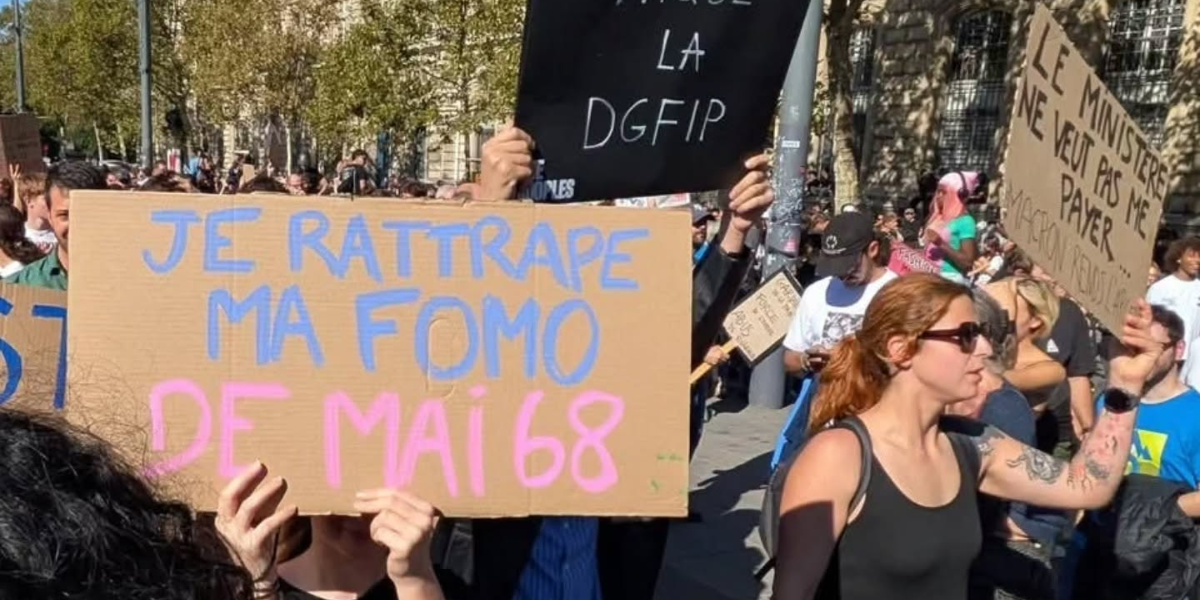
Tuesday, October 6, saw vibrant mass demonstrations in dozens of French towns, as five of the nation’s six main trade union confederations mobilized in support of the escalating school student movement. Entering its third week, the historic uprising against years of cuts in school budgets continues to gain momentum in the face of brutal police violence and state panic.
The movement has involved far more high schools than the last comparable movement eight years back. Over a thousand high schools (for 15 to 18 year olds) and over a hundred middle schools (for 11 to 15 year olds) have been blockaded. Thirty universities have joined the movement in the last few days. In every establishment, daily mass meetings decide on the day’s actions. On the demonstrations you can see thousands of homemade placards with imaginative slogans which go from quoting the 1793 Declaration of the Rights of Man (on the duty of insurrection) to quoting popular rap artists, from “Generation X, generation Z, one struggle!” to “The six-seven generation is aiming at ’68”.
The state response
Desperate to extinguish the flames of revolt, authorities resorted to mass lockouts, preemptively closing hundreds of schools and several university campuses this week.
Macron’s minority government, eager to pass its austerity budget before the end of the year, has reacted in three ways.
Firstly, with violence and intimidation. In the hope of scaring away as many young protesters as possible, they ensured that the police repression was extreme. A couple of hundred teenagers have been injured by cops, and some of the examples are heartbreaking. In the Paris region, an officer fired a tear gas canister point-blank into the face of a 14-year-old boy, shattering his jaw in two places and knocking out all his teeth; his family is now suing for attempted murder. In Tours, a 16-year-old lost an eye to a rubber bullet fired directly at him—on video, police can be heard boasting about blinding protesters. Elsewhere, multiple students suffered severe eye injuries. A viral video captured an officer pinning a young girl in a violent chokehold, while in Lens, a bystander schoolchild lost a hand to an exploding crowd-dispersal grenade (he did not “pick it up” as the media have claimed).
In a further attempt to intimidate, over five thousand young people have been arrested – only 1800 were subsequently even charged with an offence. And even now, the government refuses to rein in the police thugs. The Interior minister Laurent Nuñez spoke on Tuesday of “supposed excesses” in police action, while former minister Bruno Retailleau demanded loudly that the age of criminal responsibility be lowered.
Secondly, the government has offered tiny concessions, which are only cosmetic. Proposals to hike some higher education tuition fees were abruptly shelved, and school student union leaders have been invited to talks with the Education Minister. The regime has also launched a token online portal for grievances and they have scheduled managed “consultation sessions” in all schools for the end of the week.
Finally, a propaganda offensive is trying to paint the young people as manipulated by the radical left organization the France Insoumise (FI, “France in Revolt”). The old lie of “outside agitators” is being mobilized, because the FI is playing an excellent role in the movement. Even previously sceptical far-left commentators have written that the young protesters consider the FI to be their party. Its leader Jean-Luc Mélenchon insisted that FI Members of Parliament and local elected councillors should interpose themselves between the police and students to help protect them. All of them were present and vocal in denouncing police violence.
In parliament, the Prime Minister Sébastien Lecornu said one could not speak of “police violence” and complained that the France Insoumise “were implying that the police forces of the Republic … were racist”!
No to cosmetic concessions
School student leaders are not fooled by the cosmetic concessions, and are showing their confidence by announcing a new day of action, only two days after the previous one. Trade union leaders could learn from the youngsters, but are preferring to drag their feet and suggest a strike in November.
The established media are working hard at slandering the movement and twisting the truth. The media watchdog Acrimed measured the time spent on peak-time national news of the main public TV channel France 2 early this week, speaking of different aspects of present events. 75 percent of the time was used to speak of damage or alleged damage caused by the protesters, 8 percent concerned the movement’s demands and 12 percent government accusations of manipulation by the France Insoumise!
This uprising is taking place against a backdrop of severe political polarization in France, ahead of next May’s presidential election. Polls show the fascist candidate leading the field, with radical-left France Insoumise candidate Jean-Luc Mélenchon running second. The prominent presence of antifascist placards and banners across student marches reflects the fact that young people recognize that their struggle against austerity and police violence is directly linked to the broader fight against the far right.
Opinion polls show clearly that a majority of the population (around 62 percent according to the latest measure) support the school students’ movement. The next week will show whether much needed escalation will come.
Author
Did you like this article? Help us produce more like it by donating $1, $2, or $5. Donate