
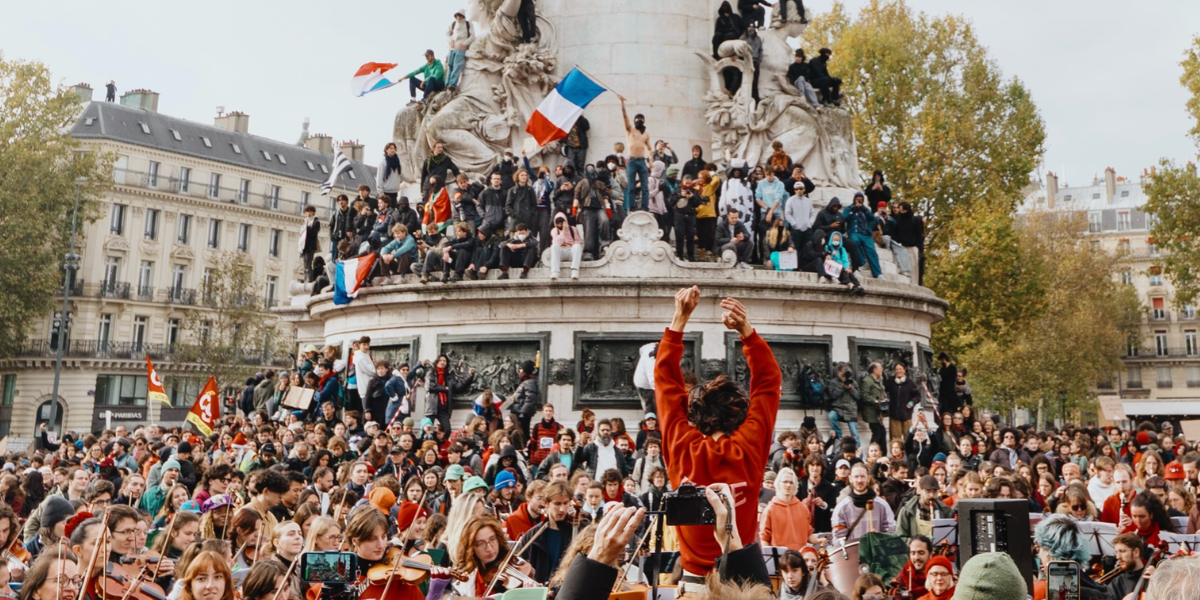
For the third time in a week, on Tuesday, November 10, France saw major strikes in education, and mass demonstrations across the country.
Well over a million people took to the streets in more than 200 towns and cities on Thursday November 5, in support of school students and demanding wage increases, more jobs and an end to cuts in public service budgets. Health workers, dockers, teachers, journalists, municipal staff, train drivers, bank workers and many others joined the one-day strike. Two days later, hundreds of thousands marched again.
Student assemblies attracted over a thousand participants at many universities, including Marseille, Rennes, Bordeaux and Paris-Cité. In some towns, notably Rennes and Bordeaux, and in sectors such as university staff and healthcare, general assemblies of workers (known as interpros or coordinations) are taking the lead in organizing the struggle, hoping to overcome the horrific inertia of the national union leaderships.
In Paris on Monday, November 9, high school student representatives walked out of a government consultation session on university admissions policy when they discovered that ministers had invited fascist MPs to take part.
The three strands of revolt
There are three strands to the present revolt. First, high school and university students are in their sixth week of blockades, and are not giving up despite the police beating thousands and mutilating dozens. Secondly, the Yellow Vest networks are back, and they worry the government because they seem leaderless and prefer wildcat demos. Most importantly, there is the workers’ movement, which holds, in strike action, our most powerful weapon, but which is held back by catastrophic national leadership from a band of professional “Bordeaux and sandwiches” negotiators.
On the demos, people wave thousands upon thousands of home-made cardboard placards, with slogans from the bawdy to the philosophical, quoting poets, rappers or constitutional documents. My favorites include: “Let’s do a poo on the fascists!” “You thirst for power, we thirst for beauty!”.“ Class struggle begins in high school!” “Looters in hoodies make you angry? Looters in suits are your government!” “Plan A: protest in a dignified manner. Plan B: smash everything up.” “Have you forgotten how we became a democracy?” and “This is getting expensive in cardboard!” The now traditional demo song ranks out across France: “For the honor of the workers, and to build a better world! Although Macron doesn’t like it, here we are!”.
Brass bands and orchestras were present everywhere, following a call from the New World Orchestra, who were tear-gassed while playing mid-October. They have popularized a brand new demo song: “I’ve two great loves: the brass band and the revolution! Long live blockades and sabotage, occupations and wildcat demos!” Groups of thousands were filmed singing this and dancing.
Popular support
Last week, a new opinion poll found that 57 percent of the entire population approved of the movement, and 88 percent considered the demands concerning purchasing power and the cost of living legitimate, while 75 percent approved student demands. Impressive, given the massive government propaganda campaign against the revolt.
With such support, even the mainstream media feel obliged to feature in their reports interviews with inspiring high schoolers explaining their demands in detail, even if the channels make sure to get rapidly back to their preferred fare – interviews with headmasters, policemen and shopkeepers who are upset by the movement, and political experts who want to discuss supposed personality clashes between left politicians.
This crisis is not going to go away. Macron’s minority government must push through the national budget before Christmas. Massive tax cuts for the rich mean they are short of money, so their initial proposal is for 50 billion euros in budget cuts. The international bankers are breathing down their necks, already charging France more than neighbouring countries to borrow money.
The crisis is not going away
The situation is extremely fluid. On Monday, November 9, the government met with unions and bosses and then declared that the national minimum monthly wage would be raised… by 24 euros. The CGT union demands 150 euros. Later this week a decision will be announced about public sector wages. Public servants have lost 20 percent purchasing power since 2010, and nearly a million are on the minimum wage.
The national union leaders are following their usual hymn sheet of “days of action”. The dynamism of Thursday’s social explosion should have convinced them to call more action immediately, but they waited “to see the results of the negotiation” which were of course pathetic. Monday’s talks with unions took place behind closed doors – they should have been livestreamed! We could do with rallies outside the weekly meetings of the leaders of the six different union confederations, to help them concentrate!
Not all the union leaders are identical. The more radical like Sophie Binet of the CGT confederation say they would like to see strikes spread further, while the CFDT is not calling for more strikes right now. But all generally move in practice very slowly.
The movements are enthusiastically supported by the radical left organization France Insoumise (France in Revolt). The result has been that FI presidential candidate Jean-Luc Mélenchon has gained a couple of percent in the opinion polls. It is unexpected to have such a huge movement within a few months of presidential elections, and the stakes are very high indeed. More mass strikes have been called by some union leaders for November 17. We need to go further.
Author
Did you like this article? Help us produce more like it by donating $1, $2, or $5. Donate