
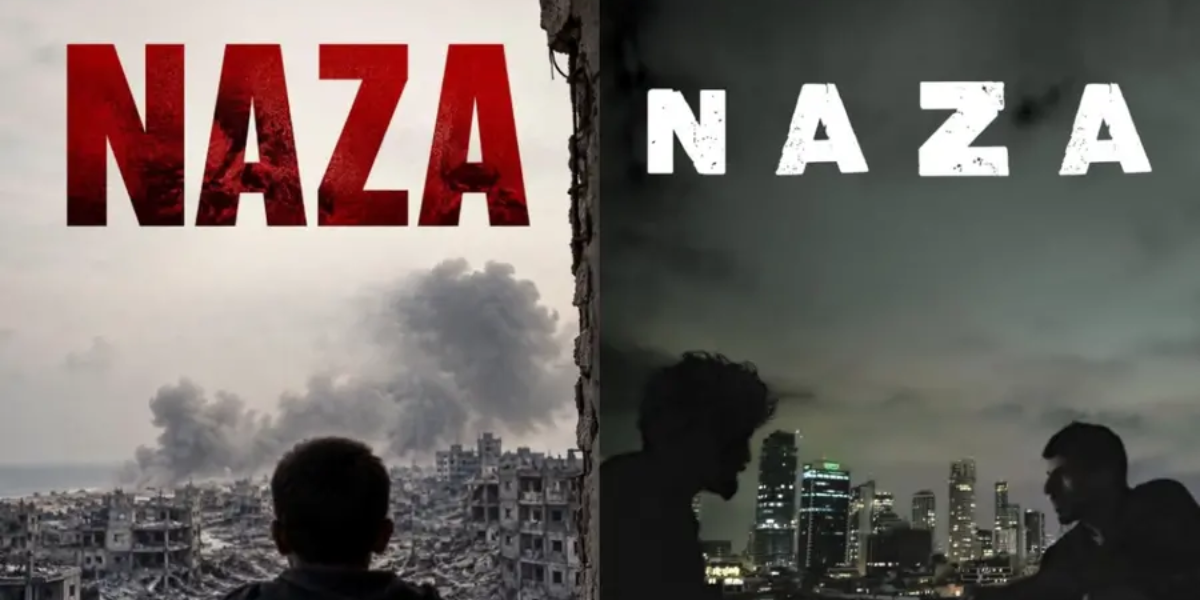
NAZA, the new documentary by Yuval Abaraham and Rachel Szor, is a movie about Israelis. Their previous movie — the critically acclaimed No Other Land (co-directed by Basel Adra and Hamdan Ballal) — focused on the struggles of the Palestinian residents of Masafer Yatta to defend their homes against state-sanctioned settler violence. In NAZA, by contrast, Palestinians are barely seen. Instead, the focus is on elite intelligence officers in Tel-Aviv who have spent the past three years facilitating and enacting the genocide in Gaza. The film offers important insights into the inner workings of the IDF killing machine, but its most important contribution is to hold up a mirror to Israeli society and puncture the myth of liberal Zionism.
The technicians of genocide
The nighttime skyline of Tel-Aviv serves as a backdrop to the movie. Abraham interviews his anonymized subjects on rooftops overlooking the city. The glass towers, lit-up apartments, traffic and city life strike an obvious contrast with what these people have reduced to rubble in Gaza, only 60 kilometres away. The interviewees describe their roles designing the AI system that determines which Palestinians are to be killed, selecting buildings to be bombed, deciding when to carry out attacks and how many civilians they will kill alongside their targets. This is the origin of the film’s title, NAZA, an Israeli portmanteau for so-called “collateral damage” — a euphemism for the Palestinian families whose obliteration seems to be the main objective, rather than a mere byproduct, of the bombings.
On the whole, the interviewees appear rather detached from their gruesome work. One describes his role in planning bombings as purely “technical.” Another says that his work designing the artificial intelligence system used to mark tens of thousands of Palestinians for death — with 85 percent accuracy, based on their phone habits — did not make him as morally culpable for mass death as the people who dropped the bombs. They talk about hearing the voices of children whom they are about to kill as if it’s just a regular part of a regular job. One asks his commanding officer what he thinks about their job, and the officer says they have to just trust the structure of the army.
This detached discussion of genocide and industrialized slaughter can only evoke the Nazi Holocaust. One interviewee makes the connection himself, saying that he now understands how regular Germans were able to do such unspeakable things.
Just doing their jobs
One can’t help but bring to mind Hannah Arendt’s work, in her classic text Eichmann in Jerusalem, on the “banality of evil.” Adolf Eichmann was a senior SS officer who played a key role in the Holocaust. He was primarily a bureaucrat, in charge of organizing deportations, scheduling trains, ensuring that concentration camps were well-supplied and fully staffed. He dealt with logistics and “technical” problems, rather than personally carrying out the mass killings. In her coverage of Eichmann’s 1961 trial in Israel, Arendt depicts him less as an evil mastermind and more as a bland and unimaginative careerist who only sought to do his job and achieve professional recognition. It doesn’t take someone who is rotten to their core to commit unspeakable evil — only someone who doesn’t think too hard about things, doesn’t ask too many questions and who seeks personal promotion.
The movie focuses on people like Eichmann: those who work behind desks in air-conditioned cubicles to design and operate systems of industrialized slaughter. They liken what they were doing to an assassination factory, to video games, to team projects in an office. It’s no surprise that the movie is co-produced by Jonathan Glazer, whose film The Zone of Interest similarly captured how the quotidian can exist alongside unfathomable violence. Glazer has said that he wanted his film to highlight the ordinariness of the death camp commander and his family in contrast to the way they’re typically presented as “almost mythologically evil.” NAZA does much the same.
The banality of liberal Zionism
Set against “liberal” Tel-Aviv (a city sometimes counterposed to the strongholds of the Israeli far-right), the interviewees do not present themselves as ultra-Zionist extremists. These are not the fanatic West Bank settlers or religious fundamentalists who menace the subjects of No Other Land, but secular Tel-Avivim in highly sought-after intelligence roles. One even makes the bizarre assertion that no one in his unit was really racist against Arabs, echoing Eichmann’s outlandish claim that “he ‘personally’ never had anything whatever against Jews; on the contrary, he had plenty of ‘private reasons’ for not being a Jew hater.”
By shining a spotlight on these particular subjects, the movie forcefully refutes the notion — often propounded by progressive American politicians like Bernie Sanders — that this is Netanyahu’s war and that Israel’s longest-serving prime minister somehow represents an aberration within the Zionist project rather than its core truth. The movie draws a line of continuity between the oft-forgotten Palestinian communities that were bulldozed to make way for modern Tel-Aviv and the present erasure of Gaza. The interviewees themselves are upper-middle-class urbanites who do not come off as Kahanists, yet it is they who describe themselves as “the tip of the spear” of the genocide. The need for moral reckoning after the destruction of Gaza goes far deeper than the far-right political elites who govern the Israeli state or the “hilltop youth” enacting violence on the fringes.
The part of the movie that most clearly evoked Eichmann was when one of the interviewees justified his participation in the genocide by saying that if he hadn’t done his job, the IDF would have simply found someone else to do it. Arendt, hearing similar excuses from Eichmann, argued that “there is an abyss between the actuality of what you did and the potentiality of what others might have done.” There might be a structure beyond you that will continue to function even if you refuse to participate, but you still had a choice and bear responsibility for the crimes you chose to commit.
Ultimately, I felt this movie lacked the emotional resonance of No Other Land, which brought Palestinian life into focus and brought the viewer up close to the brutality of the Zionist settler project in the West Bank. It isn’t clear how much new information there is in NAZA that hasn’t been exposed by outlets like +972, who have been covering the use of AI in the genocide for years. Yet, if No Other Land succeeds by showing the almost mythological evil of the settler project, NAZA succeeds in exposing the banality of evil at the heart of the genocide in Gaza.
Author

Did you like this article? Help us produce more like it by donating $1, $2, or $5. Donate