
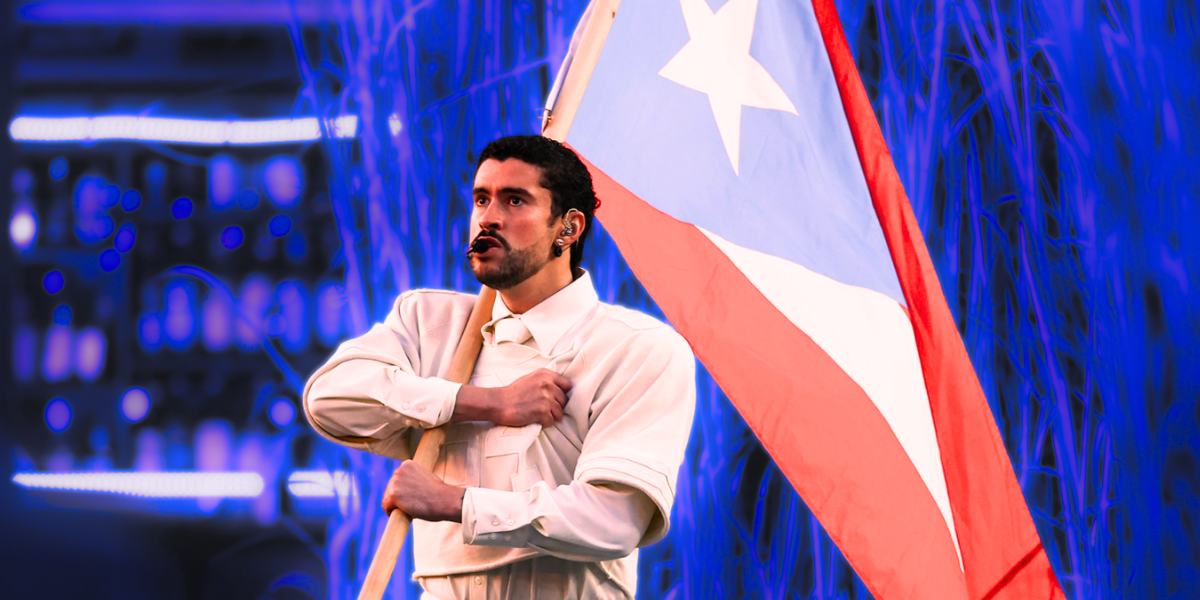
When 128 million people tuned in to watch this year’s Super Bowl, one of the world’s most corporate spectacles, they witnessed a Boricua party. Led by Bad Bunny, the fully Spanish performance showcased his irrefutable charisma and rhythms that move listeners even if they don’t understand a word of the lyrics. His music has transcended language barriers to an unseen degree, signified by his latest Grammy win for his homecoming album ‘Debí Tirar Más Fotos’ (‘I Should Have Taken More Photos’) which made him the first Spanish language artist to win Album of the Year.
Predictably, the NFL’s choice of the artist received a lot of backlash and the far‑right staged their own counter‑show, the ‘All-American Halftime Show,’ as an awkward protest that attracted a fraction of the viewership. Their outrage centered entirely on the fact that the performance was in Spanish and therefore “un‑American,” a tired argument when the US has the second‑largest Spanish‑speaking population in the world.
But what truly bothers the right is not the language. It’s that Bad Bunny speaks openly about Puerto Rico’s political injustices, from colonial neglect after Hurricane Maria to systemic infrastructure failures; flippantly being not considered a part of the USA while still suffering under colonial control. It’s not surprising that when he closed the performance with a flawless roll-call of countries across north and Latin America as a deliberate reminder of what ‘America’ truly means, it became an iconic moment as millions recognized themselves in his performance. It was a celebration of survival and insistence to experience joy.
When the left forgets to live
This performance has been debated unsurprisingly by the right, but also by the left. The far-left, for all its insight, tends to dismiss such events as ‘bourgeois distraction,’ celebrations as unserious, and joy as frivolous. This puritanical instinct is one reason the left is sometimes caricatured as ‘weird.’ This ‘all or nothing’ approach to struggle is a barrier to attracting the ordinary people who have fuller lives (and desires) beyond their workplace. Their worlds are shaped by music, family, spiritual traditions, and everyday spaces and cultural markers where they process meaning, cultivate hope, find connections and imagine different futures.
Human life is not reducible to economic determinism. It is made of things like falling in love, dancing in large gatherings or going to boring family events where a child is napping across three chairs. There are so many complexities of life that the left don’t want to embrace, perhaps why we are called ‘weirdos.’ When the left ignores this, we risk building a movement that feels heavy, insular, and emotionally unsustainable.
We need to live the life we’re building
For socialists, the role of art is more than entertainment: it’s a rehearsal for the life we desire in socialism. Until socialism exists, such an event can provide a space for people to breathe, connect, and energize for a stronger fight tomorrow. We can allow ourselves to rejoice at these moments of crisis, to feel nostalgic especially when a brief nod to Gasolina sent generations into joyful disbelief.
We can also hold two truths at once: the Super Bowl is a capitalist spectacle that commodifies culture, and we’re still allowed to feel something when millions witness a show rooted in diaspora pride and migration. Living under capitalism means most platforms are built for profit; our task is to use those platforms to spark energy and connect with the millions of everyday people engaging with them rather than rejecting them in purist disgust. No one holds the moral high ground in a society as contradictory as ours. This was the first time Latinos across the entire diaspora felt truly seen and that matters.
Enjoying a performance or other forms of political art can’t be a substitute for our day to day organizing. But rejecting joy isn’t revolutionary either. In moments of despair, Marxist dogma alone won’t inspire exhausted people. A song, a poem, a lyric often reaches where ideology can’t. If we want a mass movement, we cannot police celebration or shame people for feeling joy.
Bad Bunny’s show offered something simple and radical: a reminder that people deserve joy even before liberation. As Marxists, we understand that workers hold power when we come together. But as organizers, our job is to meet them where they’re at and make organizing irresistible. Or, as Benito himself put it: “They don’t even have to learn Spanish. It’s better if they learn to dance”.
Author

Did you like this article? Help us produce more like it by donating $1, $2, or $5. Donate