
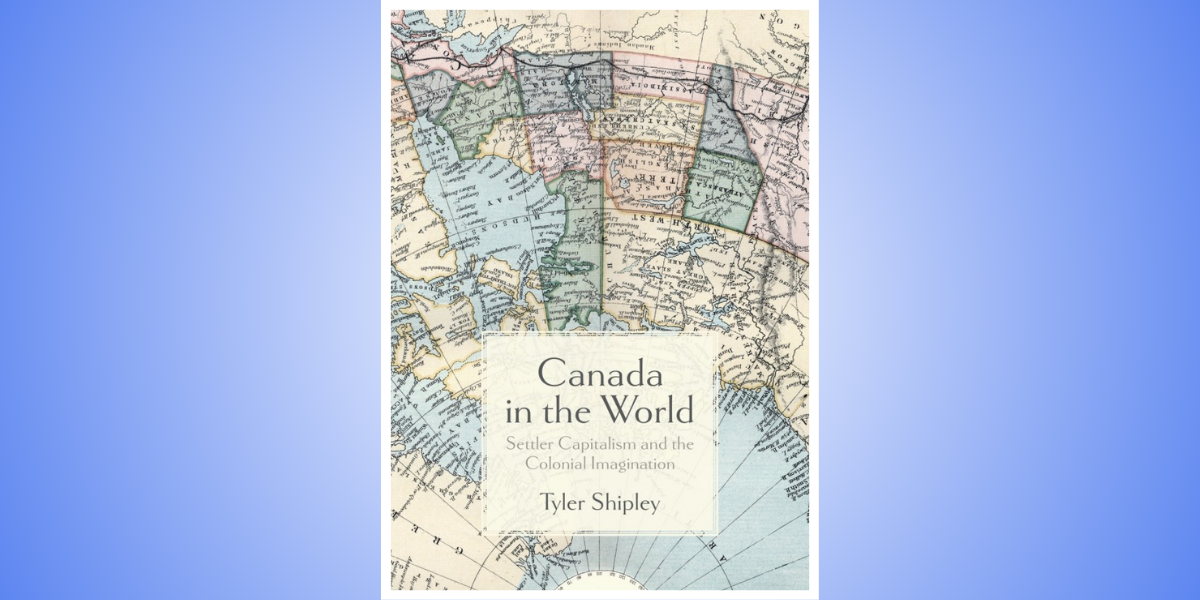
Canada in the World: Settler Capitalism and the Colonial Imagination by Tyler Shipley (2020, Fernwood Press).
Tyler A. Shipley’s book Canada in the World: Settler Capitalism and the Colonial Imagination is an incredibly useful history. It compiles a list of Canada’s crimes, giving reason to those of us who have always felt a bit icky when asked to celebrate Canada’s legacy or indulge in any manner of patriotism or Canadian nationalism.
The book fittingly starts with a quote from a Canadian Curriculum document: “When the European settlers arrived, they needed land to live on. The First Nations peoples agreed to move to different areas to make room for the new settlements.” This is perfect because Shipley’s goal is to smash the sanitized version of Canadian history with a massive dose of colonial reality. He does this very well, taking us on a tour that starts with colonial conquest and the expropriation of Indigenous lands, through Canadian foreign policy around the world, the dark secrets of Canada’s “peacekeeping” legacy and back home again to the rise of a fascist domestic politics.
Canada’s continental imperialism
Shipley treats the relations between Canadian settlers (British and French) and the Indigenous Peoples they encountered as a foundational element of what Canada would become. Meaning the logic of Canadian colonialism created a legacy that has informed Canada’s place in the world ever since. As Shipley puts it, “Canada’s colonial project was driven by one fundamental material goal–the destruction of Indigenous political economic practices and their displacement by capitalism—and an equally important ideological foundation in the claim that Europeans were racially and culturally advanced and, thus, that their conquest of the Indigenous Peoples represented “‘progress.’” The economic compulsion of capitalism and the ideological framing of white supremacy then remained essential to Canada’s actions at home and abroad.
To demonstrate this, Shipley takes the reader through the conquest and genocide at the foundation of what would become Canada and outlines the ways in which Indigenous practices and life itself became criminalized. These examples of “continental imperialism” at the heart of North American settlement help explain the role Canada has played over the last 150 years as a junior partner to British and US imperialism around the world. At every step of the way, Shipley notes the ways in which Canada acquiesced to the horrors of imperialist powers, turning a blind eye, actively profiting from these conflicts, or helping with troops on the ground.
Junior partner to US imperialism
A quick scan of some of the colonial horrors of which Canada had been a part of since confederation can be found in the chapter “Colonialism, a part of our heritage.” Shipley explains the increasing Canadian outrage at the well-televised Vietnam War, while more than 400 Canadian companies had contracts with the US Military, providing batteries and berets to the US war machine to a tune of $2.4 billion. He writes: “It had been nearly a century since the conquest of the North American west; since that time, the savagery of colonialism had been increasingly hidden from the broader white public. Canadians had not travelled with William Stairs when he beheaded Congolese people, they had not seen John Buchan’s South African concentration camps, they had not witnessed the massacre in El Salvador, and they had no idea that their soldiers had raped South Korean women.”
Canada was a significant contributor to the Cold War, always lining up with the Americans to isolate the Soviet Union and overlooking or contributing to any body count necessary to defeat the struggles against colonialism and capitalism. From supporting coups in order to secure new mining investments for Canadian companies in Guatemala to Canadian “peacekeepers” delivering Patrice Lumamba to his assassins to offering up large sections of the forests of New Brunswick to the American Army to test the Agent Orange they would drop on Vietnam, Canada has aided and abetted some of the worst crimes in order to maximize profit and ensure the dominance of the Atlantic powers.
Shipley tears apart the myths that many of us have grown up hearing; Canada’s role as peacekeepers in Rwanda and the Balkans, Canada’s role in the war on terror, Canada’s role in undermining democracy in Latin America and many more. Finally, Shipley wrestles with the turn away from the peacekeeping myths of Canada that once characterized the image projected to the world, and its current turn towards more overt and self-conscious militarism. He writes: “war and militarism have always been central to the Canadian story, because they have always been a necessary component of the world Canada seeks to build.” The Canadian project, capitalist and colonial to its core, has relied on violent coercion for its maintenance.
Canada in the World is a fantastic overview of geopolitics over the last century, unearthing the role Canada played in already well-documented histories of American crimes. For those that have read deeply on imperialism albeit focused on America, this book should be read widely by anyone looking to arm themselves with facts to counter the benevolent image of Canada being peddled by Canadian nationalists, casting the phony “elbows up” rhetoric of late in a completely different light.
Author

Did you like this article? Help us produce more like it by donating $1, $2, or $5. Donate