
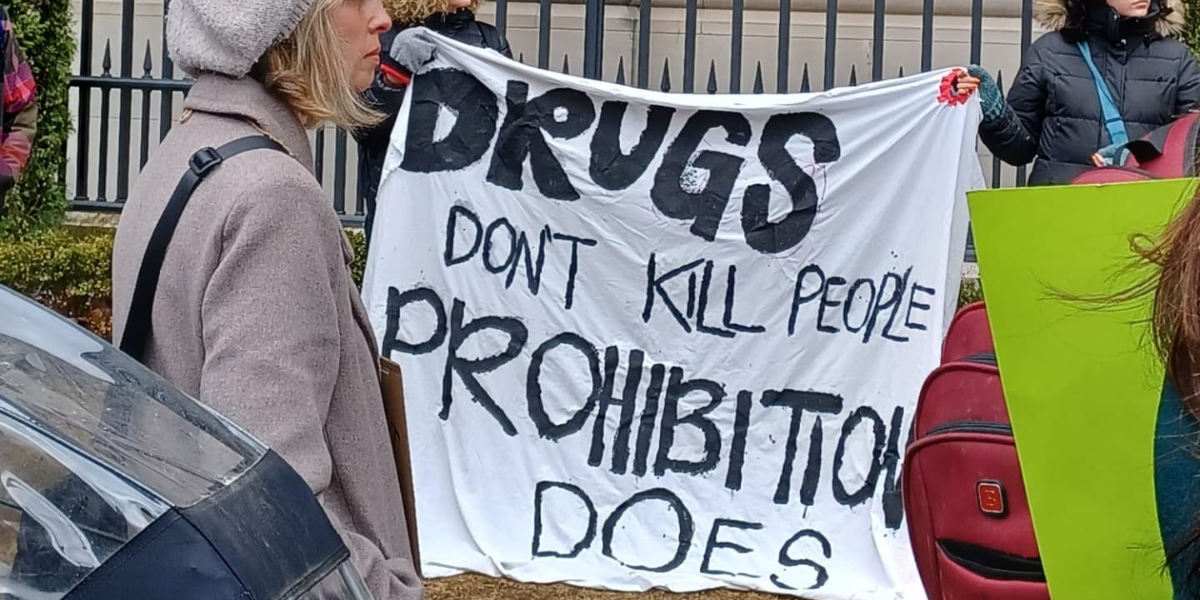
On February 23rd, CBC released an article called “Police outreach making ‘small steps’ in curbing open drug use downtown.” It outlines the outcomes of a foot patrol program initiated in 2025 by the London Police to, as stated in the piece, “engage people using drugs, refer them to supports and where necessary, conduct ‘targeted enforcement’ against drug use in public.”
This article is straight up copaganda, intended to further legitimize the expanding carceral web of policing into the non-profit and health sectors. The punitive response to drug use remains upheld, while the sheer existence of the most vulnerable people in public spaces continues to be surveilled and managed away from public view at the behest of capitalists.
In a time of escalated targeting and scapegoating of people who use drugs, it is vital to analyze the role liberal media plays in upholding narratives that further disenfranchise marginalized populations in our neoliberal cities. As discussed in a recent Spring podcast episode, journalism is not a neutral practice. Rather, like any other form of media, it is inherently shaped by constructed discourses around social, political and economic relations and interests within capitalist society. To develop our arguments for a better world, it is imperative that we understand how such carceral narratives integrate themselves within news meant to appeal to the masses.
Whose voices are heard?
The article’s second sentence is “while police say they’re seeing results, some business owners say it’s mixed.” Immediately the reader is shown which voice the writer considers the most important. The business owner, on behalf of the entire community, is heralded as the informed citizen that really knows what’s happening, and therefore knows what needs to be addressed.
Every single one of the five people quoted in the article are either business owners or directors of an organization. Every single one of them either praises the increased police presence or claims that the program doesn’t go far enough in surveilling and displacing people who use drugs.
One business owner encourages a “beat system,” where officers are more spread out, to “help deal with loitering and open drug use.” The executive director of Downtown London, a neoliberal organization that functions to appease capitalists and facilitate urban gentrification, said that “the ability of business owners to call the street patrol directly has been helpful.” Here we have a direct phone line which capitalists can use to exert their political power against the dispossessed by ordering foot soldiers to instantly disappear them.
Not one person who uses drugs is quoted in the article, let alone mentioned by name. There is a reason for the media to reject the voices of those with lived experience: subaltern knowledges are often regarded as being “beneath the required level of cognition or scientificity” as said by Michel Foucault.
Silencing people who use drugs in an article that explicitly concerns them serves to further entrench their exclusion from considerations of community concerns and safety. While the business owner and cop are regarded as representative of the worthy citizen whose voice deserves to be heard, the human living precariously in public space is reduced into shadows, othered and ostracized. When the mainstream media talks about safety, who is this safety for?
The irreparable harm of drug seizures
Not only does the article decide to omit the consequences of drug seizures in public spaces, but it also blindly praises the program as a step in the right direction. If the common reader were to engage with the article without knowing anything else about the impacts of having your drugs taken away by law enforcement, they would leave with the impression that such seizures contribute to a safer society, despite overwhelming evidence of the contrary.
Multiple studies have been released over the last few years—following the increasing number of police initiatives that infiltrate medical interventions to drug use—that show how seizing drugs from people in public space contributes significantly to increased overdose mortality. Omnipresent police raids and seizures destabilized the supply, and drugs of unknown potency have come to dominate the market. It is this very criminalization that causes the discrimination and stigmatization against people who use drugs, propagating the structural inequities that lead to substance use in the first place.
More police interactions means more chances of police violence. A recent study from the Centre on Drug Policy Evaluation found that those most likely to experience violent street encounters from police are Indigenous people, who belong to a sexual minority group and people who engage in drug use.
Normalizing cruelty
The narratives, perspectives and evidence that journalists choose to exclude from their articles is just as political as the ones they choose to include. This CBC article is but one example of how the mainstream media serves the capitalist elite to maintain the violent status quo of displacement. It is nothing new.
Such instances of moral panics around drug use condition the common reader to accept the framing of “public safety” through the lens of the property owner. To quote Alec Karakatsanis:
The moment a crime is committed by a wealthy person who is a non-stranger, people in power and many in the media immediately cannot fathom categorizing the issue as a “real public safety problem” because they have been so conditioned to think of “public safety” as solely about the ways in which people who own things manage people who don’t own things.
When such narratives go unquestioned, the desensitization towards the suffering of the most marginalized remains. Breaking the indifference towards the oppressed requires rejecting the so-called neutral media as the barometer of truth. We must conduct our journalistic practices to prioritize the voice of the voiceless. As James Baldwin put it, “ask the wretched how they fare in the halls of justice, and then you will know, not whether or not the country is just, but whether or not it has any love for justice, or any concept of it.”
Author

Did you like this article? Help us produce more like it by donating $1, $2, or $5. Donate