
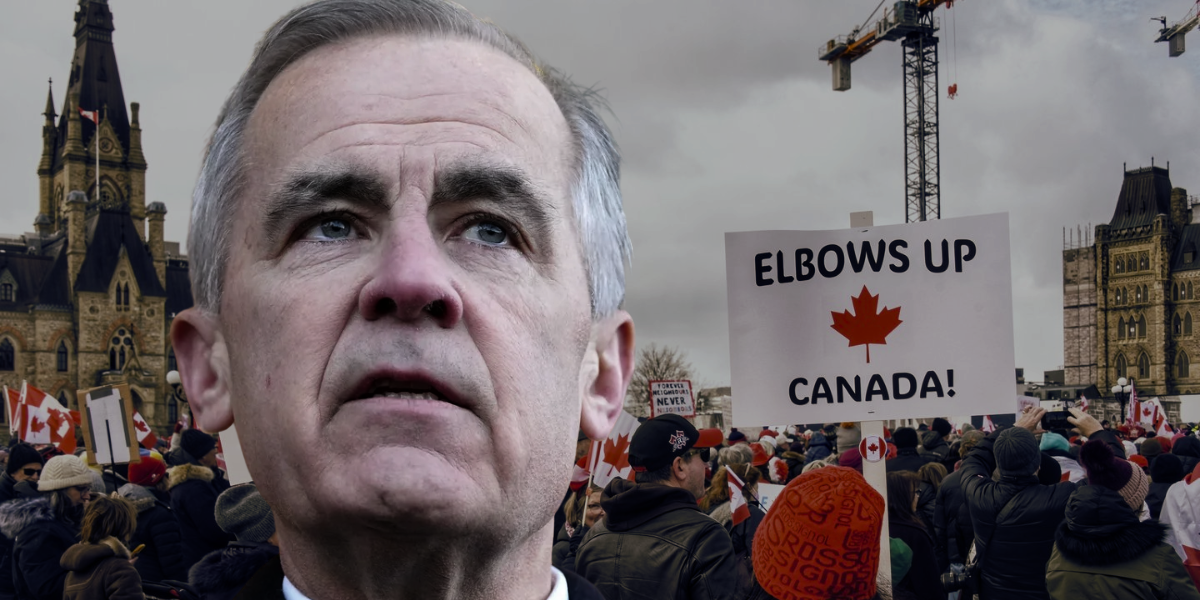
The Mark Carney-led federal Liberal government has just passed the nine month mark. Its policies have lurched sharply to the right across nearly every policy area—from workers’ rights to immigration to the environment. Its recent budget confirmed that the new Liberal government is effectively a Conservative government under different branding. Tax cuts, austerity, and a huge increase in military spending are the hallmarks of an agenda that looks far more like imitating US President Donald Trump than standing up to him.
Not a new Liberal party, but not the old one either
In many ways, the current government is a continuation of its predecessor. The Liberals under Justin Trudeau hewed closely to big business interests, reflexively prioritizing profit subsidies and privatization schemes over enhancing publicly-financed, publicly-delivered services. At the start of COVID-19, the Trudeau Liberals gave billions in corporate “wage” (read: profit) subsidies with few restrictions, letting large corporations pocket billions while attacking low-wage workers by undertaking layoffs and cruelly cutting modest wage subsidies within months. The Trudeau government also notoriously failed to live up to its commitments to Indigenous peoples, proclaiming a reconciliation agenda while failing to eliminate boil water advisories over a decade (they had pledged the number would be zero within five years), and too often fighting Indigenous groups in court rather than reaching settlements acknowledging past and present wrongs.
However, the Trudeau Liberals were not identical to the Stephen Harper-led Conservative government that preceded them. Under pressure from unions, social movements, and the New Democratic Party (NDP), they occasionally conceded modest social reforms. For instance, early in their term they agreed to enhance the Canada Pension Plan, albeit with a long phase-in period. The Liberals also legalized sale of marijuana, hiked child benefit payments, instituted a $15 federal minimum wage indexed to inflation, provided 10 paid sick days for federally-regulated workers, and brought in a modest public dental care program.
Finally, near the end of their term the Trudeau Liberals introduced the Canada-Wide Early Learning and Child Care (CWELCC) program in partnership with the provinces that cut childcare fees and helped improve child care availability. Though there is still much work to be done in further cutting fees, expanding availability, strengthening public and not-for-profit as opposed to for-profit child care, and improving working conditions for child care workers, the CWELCC represented a generational breakthrough in enhancing child care access in Canada.
The Carney government has not immediately reversed key Trudeau-era initiatives like the CPP enhancement, paid sick days, and the CWELCC. But Carney has made clear the government intends to stop introducing pro-social reforms in favour of shifting right.
The 2025 federal budget: For the few, not the many
The Carney government introduced its first budget in November 2025 (the government has stated it will move to a fall budget cycle from the traditional spring timing). Budget 2025 does three main things: 1) reduces federal revenue through tax cuts; 2) cuts direct government program spending substantially; and 3) increases military spending.
On the revenue side, Budget 2025 further erodes the federal government’s fiscal capacity. One of the first acts of the Carney government was to cancel the planned capital gains tax hike the Trudeau government had promised. The capital gains tax hike was a modest measure that would have slightly lessened the favourable treatment of capital gains (earnings from the sale of assets) relative to other types of income, like wages and salaries. It would have helped raise a bit more revenue—overwhelmingly from the rich. Cancelling it deprives the government of revenue while giving the rich a tax break.
The federal government is also cutting the first federal income tax bracket by one percentage point, from 15% to 14%. While not as regressive as the reversal of the capital gains tax hike, the income tax cut does nothing for the millions of people in Canada whose incomes are too low to pay federal income tax. Most crucially, it deprives the government of revenue needed to fund key public services—to the tune of over $27 billion over five years.
The government is maintaining current levels of transfers to persons—things like Old Age Security (OAS) and child tax benefits—as well as transfers to provinces. While there is no harsh austerity on these items, there are also no improvements. OAS (the universal portion of Canada’s public pension system) remains stingy compared to other advanced capitalist countries, and provincial transfers are growing more slowly than social need. For example, the Canada Social Transfer (CST) has been growing at only 3% for many years, despite much faster average inflation plus population growth. This means a cut in real per-capita terms, even though social need is rising in the context of a weak economy.
Where austerity is most evident is in what are called “direct program expenses”—everything the federal government does besides major transfers to persons, and major transfers to other levels of government. Direct program expenses are set to increase only very slightly from $265.8 billion in 2025-6 to $271.6 billion in 2029-30—an increase of just 2.2% over five years at a time when inflation plus population growth could average around 3% per year. In other words, the federal government is planning for big cuts in real per-capita terms.
The government’s austerity plan is even worse than it appears, because the government is planning a massive hike in military spending from 2% of GDP in 2025 to 5% in 2035. In other words, there is lots more money for the military, and much less for everything else.
Workers deliver public services, and the government plans to slash tens of thousands of public servants over the coming years. While presenting such cuts as “efficiencies,” there is no way to eliminate that many jobs without impacting services. Public servants do everything from helping workers access social benefits like EI, to enforcing environmental regulations, to preparing for future pandemics. Gutting the public service will impoverish the government’s capacity to deal with pressing social issues.
The only area of major spending increase—the military—is truly wasteful from the perspective of the well-being of ordinary people. Joining the new global arms race will only help ratchet up tensions in a world where nuclear weapons have changed the game entirely. The possibility of nuclear war has never been far away since 1945, and is now closer than at any time since the end of the Cold War. The new fighter jets, submarines, and armoured vehicles Canada plans to acquire are not only strategically meaningless in a nuclear war, but help contribute to global re-armament in a way that makes nuclear war more likely. Moving towards global nuclear and conventional weapons disarmament is the only real path to make people safer—in Canada and around the world.
Ditching climate action
The Trudeau Liberals talked frequently about the need to cut carbon emissions, but their actual track record failed to live up to the rhetoric. Emissions fell from 742 megatons (MT) in 2015 when the Liberals took office to 694 MT in 2023—a slight 6.5% drop over eight years. The Trudeau government set a target of cutting greenhouse gas emissions 40-45% below 2005 levels (emissions were 759 MT in 2005) by 2030 (a range of 417-455 MT). Clearly, Canada is far from this target, which was already too weak.
The Carney government is dropping the climate-friendly rhetoric of the Trudeau era. It is now backing away from the previous government’s 2030 emissions target, while scrapping some of the modest moves the Trudeau government made on environmental regulations. The federal government’s deal with Alberta for a new oil pipeline scraps clean energy regulations, oil and gas emissions caps, and a ban on tanker traffic off the Northern British Columbia (BC) coast, while laying the groundwork for growing long-term fossil fuel emissions.
Canada has long been a climate laggard under successive Liberal and Conservative governments. Carney’s latest moves cement that status, even as climate change accelerates.
Blaming immigrants instead of billionaires
In its dying days, the Trudeau government took a right turn on immigration. It moved to slash work and study permits and permanent residency targets while backing away from previous promises about a regularization program to help undocumented people in Canada gain legal status. Ostensibly, cutting immigration levels was to ease pressure on public services, and reduce the cost of housing.
The housing market was already cooling before the drop in immigration numbers. Housing prices peaked in March 2022 and declined sharply through the rest of that year despite high immigration levels. Many things influence housing prices, including speculation, financialization, and interest rates.
Yet the drops in prices have not restored any form of affordability. Canada has an affordable housing crisis because it has left housing production almost entirely to the market, where developers are motivated by profit rather than human need. Social housing (public and non-profit housing) construction collapsed in the late 1990s when federal and provincial governments pulled funding that they have never restored. The 2025 federal budget includes some rhetoric about affordable housing—a new program called Build Canada Homes—but the details are vague, and it is still unclear if the government really intends to return to social housing construction, or mainly funnel subsidies to private developers as the Trudeau government did.
Like housing, core public services like health care have been in crisis since the 1990s austerity regime. The cause of the crisis is billionaires pushing for tax cuts and profit subsidies instead of publicly-funded, publicly-delivered universal services.
All of which is to say immigrants did not cause worsening living standards in Canada— billionaires and their right-wing political allies did. Immigrants make enormous contributions to Canadian society, and they are not the ones who have pushed an agenda making life worse for most people. Improving living standards means taking on the champions of austerity in the business community—and in the Liberal and Conservative parties—and rebuilding public services.
What does an alternative look like?
The left in Canada and internationally is currently in a weak position. The decimation of the NDP in the 2025 federal election has emboldened the Liberals’ shift to the right.
The path towards a renewed left cannot be a purely electoral one. We need first and foremost to rebuild the capacity of the labour movement. With 5.7 million members in unions, the organized labour movement in Canada is proportionately much larger than in the US, and in many other countries. And, many more workers in Canada would choose to be in a union if they could. Labour needs to build both its capacity for direct workplace action, and its political capacity, so that it can realize the strength of its large membership. Sustained public campaigns that bring together union and non-union workers, and that unite large numbers of people against corporate greed and the political allies of big business, have the potential to turn the tide.
It is clearer than ever that the Liberals are not a centre-left party, and that waiting on them to deliver even the most modest reforms is a bankrupt strategy. Many people have lost faith in the Liberals, but see no real alternative, or are pulled by the anti-Liberal rhetoric of the Conservatives that rings hollow because they support the same agenda with a different face. Labour and the left need to rebuild peoples’ confidence that an alternative, pro-social agenda prioritizing better wages and working conditions and improved public services is possible.
Author

Did you like this article? Help us produce more like it by donating $1, $2, or $5. Donate