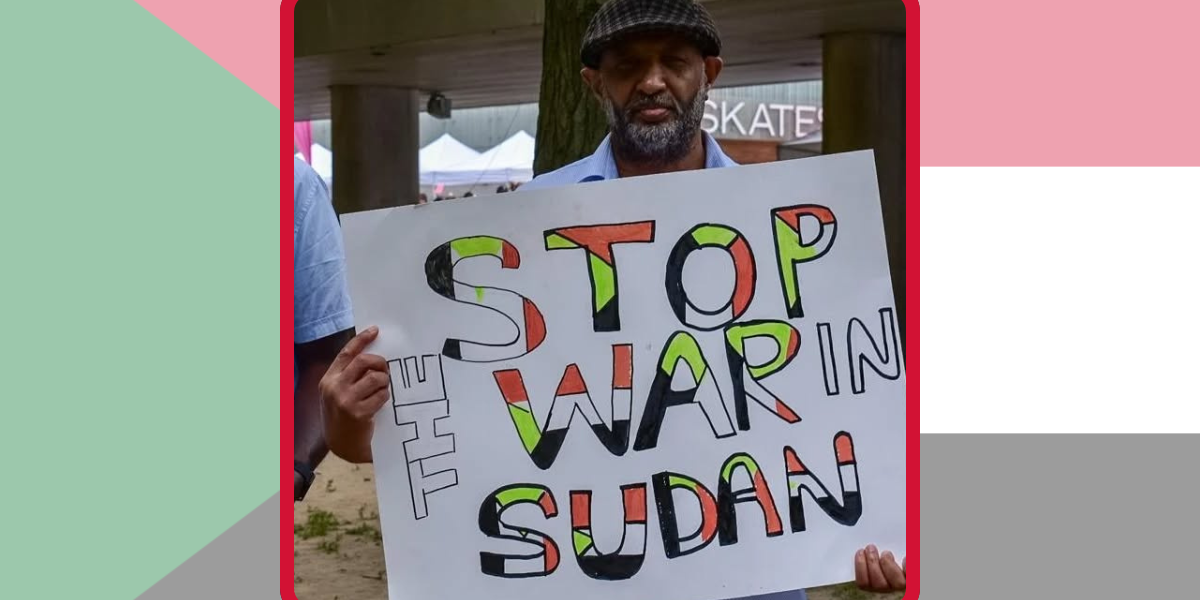
Since the defeat of the revolution that saw the 2019 overthrow of Sudan’s dictator Omar al-Bashir, the two main armed forces in Sudan have engaged in all out counterrevolutionary war. This is not a war that engages the Sudanese people in taking up sides; rather, ordinary Sudanese are the victims of two externally-backed militaries, the Rapid Support Forces (RSF) and the Sudanese Armed Forces (SAF). Millions have been displaced and killed, creating the world’s largest current humanitarian disaster.
Most recently, the mainstream media has paid more attention to this crisis, specifically the genocide taking place in Darfur by the RSF, which has now assumed control of the major cities in the region, following its rout of the SAF. Over 100,000 innocent people in El Fasher are now facing ethnic cleansing, hunger and loss of shelter and medical aid. Sexual violence is also being widely used as a weapon of war.
There are a number of layers of external support for the warring factions but the one that has become most newsworthy is the military support of the RSF by the United Arab Emirates (UAE), in exchange for gold. This has been going on for years and is one of several impediments to establishing true democracy in Sudan.
The role of Canada in the crisis in Sudan
Canadian arms manufacturers are profiting from sales to the UAE, and some of those weapons are then used in Sudan against the people. According to a CBC report, UAE is the main conduit for rifles made by BC-based Sterling Cross Defense Systems.
Furthermore, according to Canadians for Justice and Peace in the Middle East:
“The Globe and Mail reported that armoured vehicles produced by Canada’s Streit Group were found in the hands of the RSF during the siege of El Fasher. The Streit Group’s main factory is located in the UAE, and it has a history of illicitly selling weapons to Sudan and other countries sanctioned by Canada.”
Yet on November 21, while paying lip service to furthering human rights in Sudan, Carney met with UAE officials to further increase trade ties between Canada and the UAE. According to CBC reporting, Carney stated, “We welcome UAE investors to visit Canada — I will personally host them — to explore investment in Canada’s transformative projects.” To that end, Carney’s office said Friday that the UAE had agreed to invest $70 billion in Canada.
Response in Parliament
NDP Member of Parliament Jenny Kwan has introduced a private members bill, Bill C-233, An Act to Amend the Export and Import Permits Act, or the “No More Loopholes Act”. This Act would close the loophole that allows Canadian military manufacturers to export their products to the US where they are then shipped for use in the genocides in Gaza and Sudan. As Kwan stated when introducing the Bill, “When Canada signed on to the Arms Trade Treaty in 2019, the government exempted all exports to the United States from scrutiny. This loophole has become a back door for Canadian weapons, components and technologies to fuel some of the bloodiest conflicts on earth.”
But the Liberals deny any wrongdoing, instead labelling Kwan’s efforts as counterproductive. During the November discussion in Parliament, Parliamentary Secretary to the Minister of Foreign Affairs Rob Oliphant stated:
“Instead of strengthening Canada’s ability to promote responsible use and sale of military goods, this well-intentioned but misguided piece of legislation has wide-reaching implications, and it would have unintended consequences. We are working to fulfill our NATO commitments. We want to bolster security and defence industries. We want to diversify trading partners, and this bill would put us out of step with our allies …the security of NATO is something that Canadians depend on. That does mean, for us in the House today, that we need to keep our NATO obligations and build upon them. This legislation would undermine that.”
Demands on the Canadian state
University of Toronto professor and Sudanese activist Nisrin Elamin spoke at November’s meeting of Canada’s Standing Senate Committee on Foreign Affairs and International Trade, where she brilliantly outlined the issues and made demands upon the Canadian state. These include:
- Imposing an arms embargo and trade restrictions on the UAE until it stops arming the military in Sudan: the UAE is Canada’s biggest trade partner in the Middle East, so the government should use this economic leverage to pressure the UAE. In addition, the government should hold Canadian arms manufacturers accountable by supporting Bill C-233 to amend the import and export of military products and services;
- Delivering humanitarian aid to Sudan, whose people lack food, shelter and medicine, including to north Darfur to areas not controlled by the RSF or SAF, where safe delivery of aid can be made by local partners;
- Given the horrendous displacement of Sudanese people, creating a special immigration program modelled on what was used for Ukraine: there is currently a 100:1 ratio of Ukrainian refugees to Sudanese refugees in Canada. The government needs to reverse its racist anti-Black system and prioritize expedited processing for Sudanese refugees; and
- Supporting an immediate ceasefire and arms embargo so that local grass-roots committees and civil society in Sudan are centred in future peace negotiations.
Solidarity efforts
There will be a rally in solidarity with anti-war Sudanese people to be held in Toronto on December 19th, a “Revolution for Peace March”. Spring will be sharing forthcoming details on social media at @springmagca.
For more information on the crisis in Sudan, please contact the following solidarity organizations:
Thanks to Duha Elmardi, an activist in the Sudanese diaspora and Montreal-based member of the Sudan Solidarity Collective, for recommending the following:
- For solidarity: Impact Project for Humanitarian assistance for Sudanese refugees in Adre, Chad
- For a list of further references and resources, please click here.
Author
Did you like this article? Help us produce more like it by donating $1, $2, or $5. Donate