
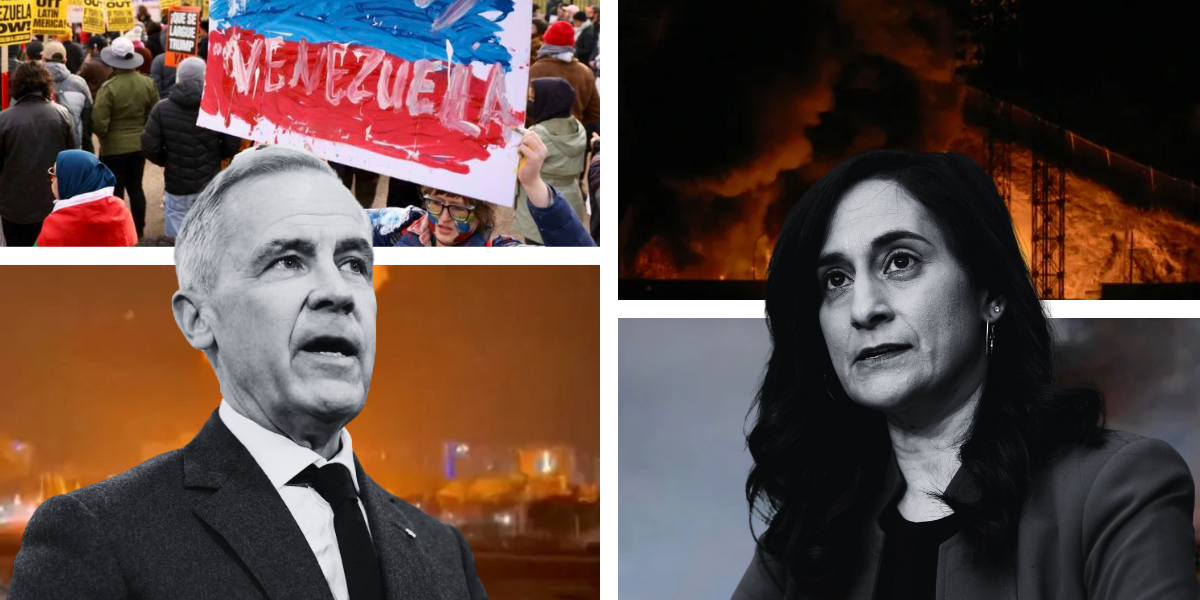
On Saturday morning the U.S. announced it had bombed several targets in Caracas and captured the President of Venezuela Nicolas Maduro and his wife. While details are still emerging, at least 40 people died during the attack as well as 32 Cuban soldiers. There are still many questions about how the U.S. was able to pull off this raid. What is clear is that the bombing of Venezuela and capturing of its president was clearly a violation of international law and an act of war.
Maduro and his wife have been brought to New York and have been indicted in court on charges to do with narco-trafficking—they will be tried in Miami. On the face of it, the indictment is riddled with factual errors and specious logic that test credulity. The Trump administration is trying to paint this as police action in the war on drugs and a big win for the U.S. They have loudly proclaimed that this action will allow for the revitalization of the Venezuelan oil sector (which has struggled under sanctions). This, of course, is not about access to oil directly as Venezuelan oil already flows into the international oil markets, but about control of the sector and more specifically into whose hands does the revenue from the sector flow. However, this should not simply be seen as a crude grab for oil—this is about reasserting U.S. power in the region and sending a message to others in Latin America that they better get in line or face the same fate. Trump, who is far less subtle than other U.S. presidents, made this perfectly clear when he said the leaders of Colombia, Mexico and Cuba could be next.
The direct U.S. assault on Venezuela, which started with the illegal targeting of boats in Venezuelan waters, is an extreme example of the U.S. floating international law. Of course the U.S. routinely defies international law and empowers its proxies, such as Israel, to do so on an extreme scale. When the U.S. invaded Iraq in 2003, it felt the need to at least go through the motions of winning international support and UN approval for its actions. While it failed to do so and took unilateral action, it always tried to present its case for invasion with some credibility. This recent action has none of the pretense of following an international rules based order.
Although flouting international laws and committing crimes of aggression is hardly new for the U.S., the manner in which it is doing it and the response by the international community going along with it is troubling. While states such as Colombia and Mexico have come out against this illegal action, the UK, France and Canada have all expressed varying levels of support. They have failed to recognize the flagrant violation of law of this unprovoked act of war.
Canada’s response
Anita Anand, Canada’s Minister of Foreign Affairs, issued a statement within hours of the news. She stated Canada has refused to recognize the legitimacy of Maduro’s President after the controversial 2024 elections and that in keeping with “Our long-standing commitment to upholding the rule of law and democracy, Canada calls on all parties to respect international law.” This statement is bizarre to say the least. Canada claims to uphold the international rule of law but also fails to condemn an illegal invasion and bombing of a country?
Prime Minister Mark Carney’s statement later that same day went further stating Canada “welcomes the opportunity for freedom, democracy, peace, and prosperity for the Venezuelan people[…] We stand by the Venezuelan people’s sovereign right to decide and build their own future in a peaceful and democratic society.” This is blanket support for the bombing of the country and the capture of its President. The blatant hypocrisy of proclaiming to support a peaceful transition and international law while providing political cover for war does not register with our leaders, nor does it warrant mention from our media.
While Trump (and Carney) hopes the brief bombing of Venezuela and kidnapping of Maduro is a quick way to assert their control and alter the balance of forces in the region this is unlikely to be the case. The situation in Venezuela could easily spin out of control into more violence in the country and wider region.
A violent multipolar world
This move is not about the overwhelming global dominance of the U.S.; rather it reeks of hemispheric retrenchment and acceptance of a multilateral world with spheres of influence. Trump’s recently released National Security Strategy seems to accept this multipolar world, and pivots away from bellicose confrontation with China and Russia and towards emphasizing a “hemisphere that is free of hostile foreign incursion or ownership of key assets.” This is unlikely to be done via full scale invasions and regime change, but through violent unilateral actions of leadership decapitation (or threats of) and economic pressure on the remaining ruling class.
This is not a world where states even feign caring about international law. This is a recipe for greater instability and more war. The violence of the 2020s—the Ukraine war, genocide in Gaza, the bombings of Iran, Lebanon, Syria, Iraq, Yemen, UAE and the Sudan war are not aberrations; rather, they paint a picture of the future. To counter this we need an antiwar movement in this country. To do that we need to build a movement that aims to speak to the wider working class, not just Left.
Author

Did you like this article? Help us produce more like it by donating $1, $2, or $5. Donate