
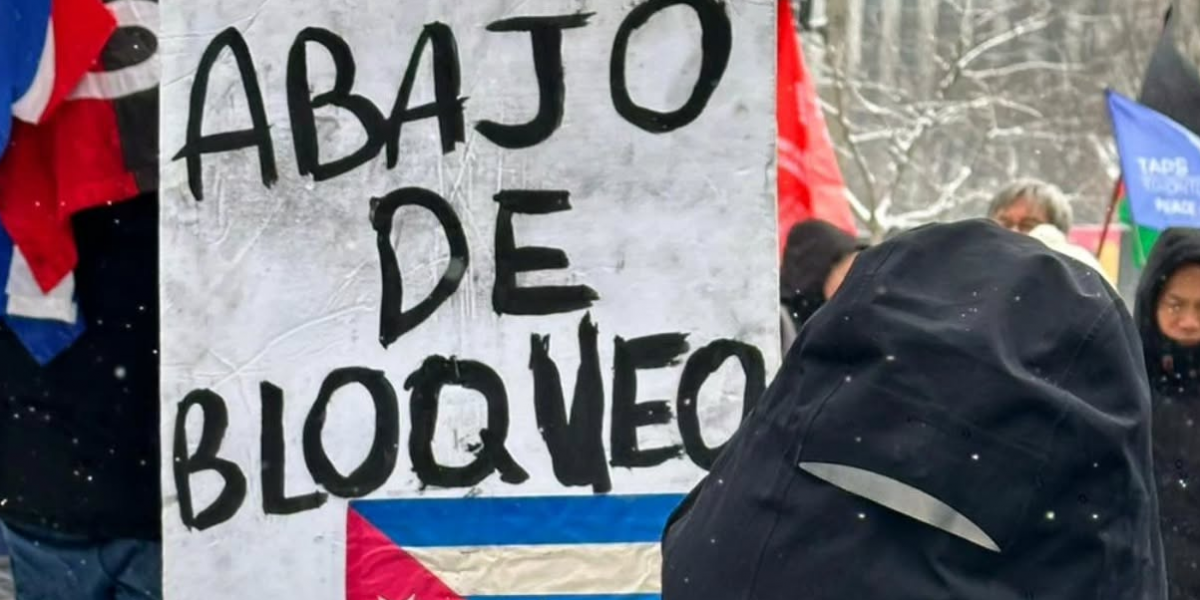
For over six decades, the US government has imposed a crushing economic blockade on Cuba, aimed at punishing Cubans for choosing a political model not to Washington’s liking. The explicit purpose of the US blockade has always been to degrade Cubans’ living conditions in order to produce hunger, desperation, and overthrow of government, as spelled out in the infamous April 1960 memorandum written by US State Department official Lester Mallory. By 2022, the Cuban government revealed that the US blockade had caused cumulative economic losses exceeding $150 billion USD.
In late January, the Donald Trump administration tightened the economic strangulation of Cuba by imposing a fuel blockade on the small, peaceful island nation. In doing so, he has precipitated a major humanitarian crisis while running roughshod over international law, including the United Nations Charter, which seeks to protect nations’ sovereignty and self-determination while prohibiting aggressive interventions. Cuban schools, universities, hospitals, farms, public transportation, and more are on the verge of collapse due to Trump illegally depriving the island of the fuel needed to power its outdated electrical grid.
Of course, the US blockade has been illegal since its inception. In 2023, a group of European lawyers convened the International Tribunal Against the Blockade of Cuba in Brussels. The tribunal’s final report, titled Denunciation of a Crime, concluded that “the extensive political and economic sanctions imposed on the Republic of Cuba since 1960 up to date violate international law” and aim to “destroy the social, economic and cultural achievements of the [Cuban] revolution of 1959.”
Every year for the past thirty-three years, almost every country represented at the UN General Assembly has voted to condemn the US blockade of Cuba. Canada has consistently voted with the global majority on this issue. Concretely, however, the Canadian government can do much more to support Cuban sovereignty and self-determination. Doing so would reflect the values espoused by Prime Minister Mark Carney at his speech to the World Economic Forum on January 20 — namely, “respect for human rights, sustainable development, solidarity, sovereignty and territorial integrity of the various states.”
On February 25, the Canadian government announced $8 million in food aid to Cuba. It’s not enough. To truly help the Cuban people, Canada needs to break Trump’s illegal and aggressive fuel blockade. That means ignoring the US president’s petulant threats and dispatching thousands of barrels of Canadian oil to the island to replace, at least partly, the Mexican and Venezuelan oil shipments that Trump has blocked from entering Cuba.
Cuba is not an international pariah. The Caribbean country has been recognized for its contributions to international solidarity and global governance. For one, Cuba currently sits on the UN Human Rights Council, having been elected for the 2024-2026 term (Cuba has been elected to the UNHRC six times since the council’s founding in 2006). Cuba has historically maintained a strong presence on other UN bodies and committees. Across the globe, Cuba has a glowing reputation for its world-class medical system, biomedical advancements, achievements in gender equality and sustainable development, and international solidarity including medical brigades and literacy programs.
For Canada, standing up for Cuba means helping to relieve the suffering of 11 million people in our hemisphere. It means standing up for sovereignty, self-determination, and international law. It means standing up to a global bully that has its sights set on Canada as well.
If Ottawa helped break the US fuel blockade on Cuba, the Government of Canada would demonstrate to the Canadian people and the entire world that they truly believe in the global vision articulated by Prime Minister Carney in Davos. If Canada refuses to defend Cuba, Carney’s words at Davos will be exposed before the world community as hypocrisy and opportunism.
Author

Did you like this article? Help us produce more like it by donating $1, $2, or $5. Donate