
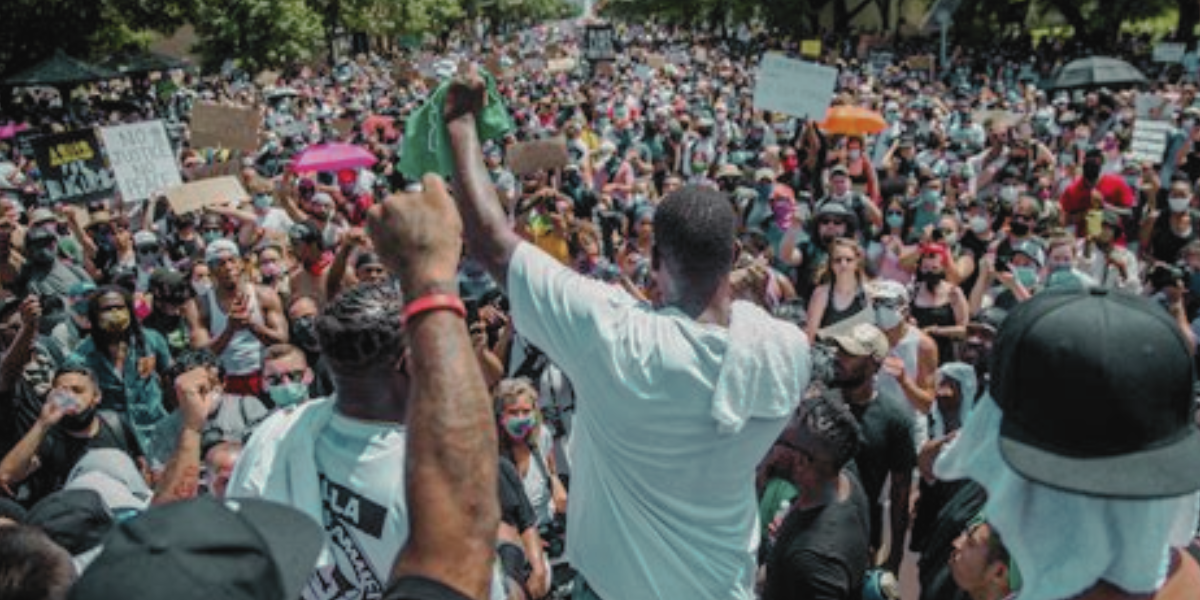
The recent backtracking by prominent Democratic Socialists of America (DSA) politicians, most notably Alexandria Ocasio-Cortez and Zohran Mamdani, on the call to defund the police has confused many on the left. Some are understandably disappointed and angry, pointing out that these DSA politicians owe part of their rise to the Black Lives Matter (BLM) movement, which propelled the demand for defunding the police into mainstream U.S. politics. Others defend the backtracking as a good political move, citing that the demand does not poll well in elections. For what it’s worth, it is an attempt at an honest argument. It is understandable why DSA politicians — who believe societal change can only come through parliamentary struggle — would say and do anything to win a seat in parliament. This explains why when the BLM movement was strong and the demand to defund the police was popular, they quickly supported it; but when the movement retreated, they were just as quick to denounce it.
For those of us who believe that systemic change can only come from mass movements, the questions we need to ask are: How did the BLM movement go from one of the biggest and most influential mass movements in modern history to a movement in retreat? More importantly, what can we learn from its experience?
One of the best resources for understanding the BLM movement is Keeanga-Yamahtta Taylor’s From #BlackLivesMatter To Black Liberation. In this book, Taylor provides a Marxist analysis of the development of systemic anti-black racism in the US as well as the various Black liberation movements that have emerged to challenge it. This article, however, focuses on the lessons she offers on the BLM movement, particularly her analyses of the debates that arose between activists over political strategy, tactics, organizational structure, and democracy. These debates remain alive today and are highly relevant to anyone building a mass movement against capitalism.
A centralized vs. decentralized movement
The first and most consequential debate within the BLM movement centers on organizational structure and leadership. While some movement activists advocated for a centralized structure and formal leadership to coordinate the movement, its most influential activists preferred a decentralized, leaderless structure, believing it to be the more democratic model. Taylor, however, disagrees. She argues that the absence of centralized structure and leadership does not eliminate power and hierarchy. She explains that decentralized structures will always produce invisible leaders who exercise significant influence without being accountable to the movement’s participants. Taylor writes:
“… all movements have leaders; someone or some group of individuals are deciding that this or that thing will or will not happen; someone decides whether this or that resource is used or is not used; someone decides whether this or that meeting will or will not happen. The issue is not whether there are no leaders; it is whether those leaders are accountable to those they represent. It also matters how those leaders are determined as leaders.”
Moreover, she points out that without a formal structure, movement activists have no space to collectively assess, debate, and decide the movement’s direction. As a result, the disagreements between activists were often expressed on social media and often devolved into personal attacks, fueling animosity and driving people away from the movement.
Another problem with the insistence on a decentralized and leaderless movement is that anyone or any group could create its own list of demands and present it as the movement’s demands. This led to overlapping and muddled demands across different groups in the movement. Additionally, the lack of formal structure and leadership to coordinate meant there was no clear mechanism to act on the demands, assess progress, and determine whether the demands needed to be adjusted.
Movement’s demands: Reform or revolution?
While Taylor does not prescribe specific demands for the BLM movement, she identifies several political considerations that should inform the process of determining them. She praises the BLM movement for linking police violence to the American capitalist system; however, she advocates for a narrow list of winnable demands. She writes,
“Demanding everything is as ineffective as demanding nothing, because it obscures what that struggle looks like on a daily basis. It can also be demoralizing, because when the goal is everything, it is impossible to measure the small but important steps forward that are the wellspring of any movement.”
She explains that choosing a narrow list of winnable demands does not mean abandoning the struggle to ultimately abolish the capitalist system. Rather, she sees the narrow list of winnable demands as the means to build the political capacity necessary for a more transformative struggle.
Taylor’s approach to movement demands is closely connected to her understanding of mass action. For her, demands should be formulated in such a way as to draw as many people as possible into mass action where they can develop their politics and organizing capacity to take on bigger and more radical demands.
Decades ago, Russian revolutionary Leon Trotsky reached the same conclusion, stating, “the greater is the mass drawn into the movement, the higher its self-confidence rises, all the more self-confident will that mass movement be and all the more resolutely will it be capable of marching forward, however modest may be the initial slogans of struggle. And this means that the growth of the mass aspects of the movement tends to radicalize it.” The 1917 Russian Revolution began with a simple demand for “Bread, Land and Peace,” but through mass struggle it grew into a demand for revolution.
Mass action vs. direct action of small cells of “radical” activists
According to Taylor, the insistence on a decentralized organizing model has led to a lack of democratic debate and strategy planning in the BLM movement, which then led to a de-emphasis on mass actions and mass marches. Consequently, actions became smaller, more secretive, and were led by small groups of activists who were then more vulnerable to arrest.
This created a vicious cycle: as activists prioritized smaller, high-risk direct actions, more ordinary people were left out of the movement, and as mass marches shrank, activists doubled down on those small, high-risk direct actions. Taylor writes, “This cycle of smaller, arrestable actions became a self-fulfilling prophecy as many of those activists decried others’ lack of willingness to sacrifice. “The smallness and marginality of the protests became a moral cudgel with which to beat people who were not willing to risk arrest.” Moreover, these activists would denounce any group that opposes small direct actions and favours the harder work of organizing mass action of ordinary people, labelling such groups as not “radical” enough.
Some BLM activists have even reached the problematic conclusion that mass demonstrations are ineffective and won’t lead to change. Taylor challenges this assumption. She explains that mass actions are important because they create the possibility of change by exerting the force of many against the resistance of the few and, equally importantly, participation in mass actions helps people develop their politics, learn how to organize, and become leaders. She writes, “Mass action breaks us from the isolation of everyday life and turns us into political actors.”
Connect the movement with organized labour — Bring the protests into workplaces
Taylor argues that the long-term strength of the BLM movement will depend on its ability to build alliances with other movements, particularly with the workers’ movement. She states that police violence cannot be understood in isolation from the broader economic and social struggles. Thus, connecting the struggle against police violence and systemic racism to the broader working-class struggle for higher wages, better welfare, and public services can broaden the movement’s reach.
She writes, “Developing alliances with organized labour could lead to workers exercising their power to shut down production, services, and business as usual as pressure for concrete reforms concerning the policing state.” In 2015, BLM activists across the US organized a “shut it down” campaign calling for supporters to block political events, highways, retail establishments, and other public spaces. In Oakland, California, the International Longshore and Warehouse Union (ILWU), Local 10, shut down Bay Area ports and halted the flow of millions of dollars’ worth of goods. This was the first major union work stoppage in solidarity with the BLM movement.
Moreover, Taylor highlights the reciprocal relationship between social movements in the streets and workers’ movements in the workplaces. She explains that the Black liberation movements in the 1960s and 1970s became most powerful when they connected the fight against systemic racism to broader fights against class inequality and workers’ rights. This connection broadened support for the movement among Black workers and other working-class communities. At the same time, the high level of political activism in Black communities also benefited the workers’ movement, as hundreds of thousands of Black workers brought their political consciousness and organizing experience into their workplaces. Taylor notes that the strike wave that hit the US from 1967 to 1974 coincided with the most militant phase of the Black liberation movement.
How movements should interact with political parties
Another critical debate within the BLM movement concerns how to engage with political parties. Taylor identifies the Democratic Party as a greater threat to the movement than the right-wing Republican Party. While the Republican Party is an obvious opponent, the Democratic Party presents itself as an ally while concealing its true intent: to co-opt and deradicalize the movement, and direct its energy into electoral support for the party’s candidates.
Taylor points out that the Democratic Party’s influence over the movement was stronger during the periods of low mobilization. In these periods, activists saw engaging with the party establishment as the more realistic strategy to advance.
One way this strategy manifests is through the emphasis on policy platform initiatives as a practical path forward. This shifted the movement’s focus and resources away from mass action and mobilization toward working with party officials, supporting candidates who pledged to adopt the policy platform, and even mobilizing voters to elect them.
While she agrees that the BLM policy platforms could be transformative if implemented, she warns that achieving them would not be possible without powerful mass movements in the streets and workplaces pushing the ruling class to actually implement the policy platform. Taylor writes, “It is easy to call for the moon and stars — and sometimes it is necessary to imagine what freedom might look like — but after the demands have been made, someone has to fight to make them a reality. The platform could not answer the central question of how to harness the physical power of social movement to do just that.”
All the movement debates Taylor identifies in this book remain alive for BLM activists and relevant to anyone looking to help build a mass movement capable of transforming the world. It is important to note, however, that Taylor published this book in 2016, during the Obama presidency and before the massive wave of mass protests that was sparked by the police killing of George Floyd in 2020. The election of Trump and the 2020 uprising undoubtedly generated new strategic debates among BLM activists, including over how to organize under the right-wing Republican Party administration as well as how to relate to the rising popularity of the DSA.
Keeanga-Yamahtta Taylor will be speaking at The Many vs The Money teach-in in Toronto on September 12th.
Author

Did you like this article? Help us produce more like it by donating $1, $2, or $5. Donate