
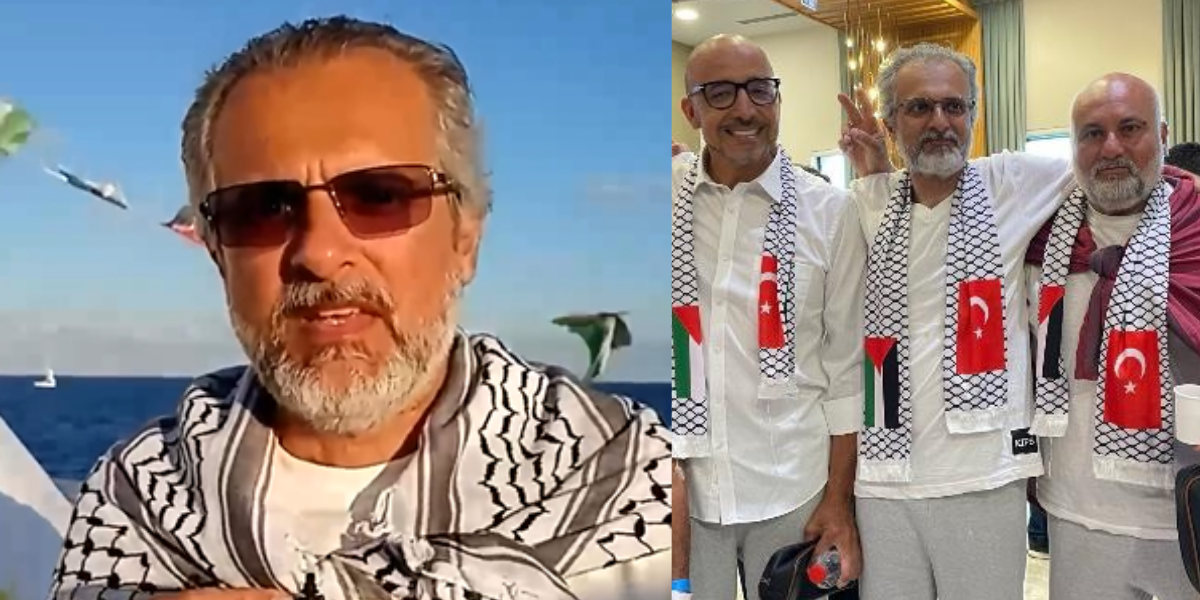
Khurram Musti Khan is an anti-war activist based in Milton, Ontario, who was onboard the Canadian contingent of the Freedom flotilla that set sail earlier this fall to break Israel’s siege on Gaza. Bryan Thevanayagam spoke with Khurram about his activism, his participation in the flotilla, and what everyday people in Canada can do to oppose Israel’s genocide.
BT: To start, Khurram, can you tell us a little bit about yourself?
KMK: My father was a leftist politician, and as a child I started going with him to demonstrations and protests, so I actually got into political activism at a very young age. His struggle started with the national liberation movement in Balochistan. And then later, his views evolved and he joined the leftist movement in Pakistan, because he thought that the national liberation struggle is incomplete without class struggle. He realized that the poor and oppressed in other parts of Pakistan have, more or less, the same issues with the poor and oppressed in Balochistan. The only difference is Balochistan had a liberation movement because it had a history of occupation, which resulted in the denial of legitimate rights of its people—somewhat similar to the situation in Palestine. And so, I used to accompany my father to protests and demonstrations. I used to listen to him and observe his struggle for social justice for his people, in particular, and for all, in general. And this sort of formed my ideas in my initial years on issues of social justice.
I started my career as a journalist. I used to write mainly on social issues. Then at one time, when Pakistan and India detonated their nuclear devices, I became a peace activist and advocated for disarmament of nuclear weapons in South Asia and the world. We formed the Action Committee Against Arms Race and held demonstrations in support of peace, against nuclearization of the subcontinent, and by extension, the world. I went to Japan as part of the Pakistan Japan Youth Cultural Exchange Program, and had the opportunity to go to Hiroshima as well, where I visited Ground Zero, the place where the atomic bomb was dropped. Prior to that, I interviewed Hibakushas—the Japanese Atomic war survivors—and their stories were published in Pakistan’s major English newspaper where I was working at the time.
As I grew up and started studying the Quran, I learned that fighting against oppression is not only a leftist ideal but a religious obligation as well, and that shaped my thought. I believe that people should work together in solidarity and struggle for the rights of the oppressed irrespective of their religion, colour, creed, caste, nationality or ethnicity.
In the last two years, you’ve been organizing for Palestine, essentially since the beginning of the genocide. Can you tell us a little bit about your organizing in Milton surrounding Palestinian liberation?
My active involvement in the Palestine cause started two years ago when the genocide started in Gaza. At that time, I contacted my Palestinian and pro-Palestine friends in Milton to do what we can to stop this genocide. And so, we formed the Friends of Palestine Canada. We held a few protests under Friends of Palestine Canada. We started contacting our elected representatives, trying to pressure them to be more vocal on this issue, to call for a ceasefire, to call for the end of the genocide.
We also formed the Milton Palestine Action Committee, which is an alliance of three main pro-Palestine groups in Milton: Friends of Palestine Canada, Milton Muslim Moms, and Milton for Palestine. We also work closely with Oakville for Palestine, and we work in solidarity with Labour for Palestine and Independent Jewish Voices to stop the genocide and work for the liberation of Palestinians. And so, with that, we continue to work on the political activism side of things as well as the advocacy side of meeting our public representatives and pressuring them to take a more stronger approach on Palestine.
How did you end up joining the flotilla?
I came to know about the Freedom flotilla through a contact. I applied to join and I was selected through the Canada Boat to Gaza campaign. I was told that I have to be in Italy within, like, four days.
I informed my wife and children about the mission. My wife was very worried and wasn’t in agreement at first, but she eventually came to terms with it. I actually left my will with her because I did not know if I’d be able to return or not. And so, I went to Italy.
We had two days of training, including non-violence training because the flotillas are basically non-violent direct action missions challenging Israel’s illegal blockade of Gaza and trying to open up a maritime humanitarian and trade corridor for the people of Gaza. On Sept 30, we boarded the vessel called Conscience, or Al Damir in Arabic. Now, this same vessel was bombed by Israel back in May 2025. I think it was like 10 to 12 nautical miles from the coast of Malta. And they literally bombed it. And then Turkiye repaired this vessel within a span of like three months.
Could you say how you were feeling during that time when you were on the flotilla?
I did have an idea about the difficulty of the voyage. Now, my only issue was my condition of severe motion sickness. I did not have any experience of sailing on a vessel in the sea for so many days. There were 92 passengers on board, including the crew and so there was limited space for everyone. It’s not a comfortable journey.
Before going on the flotilla, I was actually on a half-day hunger strike in solidarity with the people of Palestine because they were being forcibly starved. And, as a Muslim, as a human being, it was difficult for me to have three meals while people were being forcibly starved and did not have meals in Palestine. So I cut down one meal from my diet. When we went on the vessel, we were told there was going to be two meals: one at 10 a.m. and then one between 6-7 p.m., which was good for us because they were trying to train us for what was coming. There was a cafe sort of a place where they had chairs and tables, then there was the main and upper decks. And so, we spent most of our time chatting with other participants, making friends, checking social media and the latest news on Palestine.
So at that time, the Sumud flotilla was nearing Gaza and we were a bit behind them. And then we came to know that they got illegally intercepted and they received bad treatment from Israelis, especially mistreatment of Greta [Thunberg]. And so we were like, “Okay, we should expect more or less the same treatment.” But then, in Europe, there was a strong reaction when they illegally intercepted the Sumud and illegally detained all our friends and comrades. And so, I think that reaction had put some pressure on the Israeli extremists and terrorists.
So we sailed for like eight days and we were joined by the thousand Madleen boats on the way. We were like 145 people representing 30 countries in those nine vessels. The main vessel was the Conscience and then there were eight other smaller boats. And we were taking with us medical supplies and nutrition supplements worth $110,000 US dollars. Our boat basically consisted of medics and journalists, and humanitarian and pro-Palestine activists like myself.
You mentioned how flotilla activists who were detained experienced abusive conditions from the Israeli Army. What were your conditions like in detainment?
Once they illegally intercepted our vessel and kidnapped us, they confined us to the cafe area in the vessel until we reached Ashdod, which took us about 12 hours. And so during that time, as an act of resistance I continued to wear my kuffiyeh in front of Israeli naval commandos and started reading a book called “Gaza in Crisis: Reflections on Israel’s War against the Palestinians,” which one of the participants had loaned to me. I started reading the book in front of the Israeli occupation forces sitting in the front row seat while they were standing right in front of me.
The interception was very fast. There were helicopters, boats, frigates. The Israeli occupation forces conducted a major operation. At one time an Israeli commando aimed his gun at me while I was wearing my kuffiyeh. Alhamdullilah (Praise be to God) I wasn’t afraid and wore my kuffiyeh on top of my life jacket.
Wow.
Then they called me for interrogation and asked, “Someone threw something in the water a minute ago. What was it?” Then they tried to threaten me with a taser but I did not reply and remained calm. I believe this calmness was a gift from God, that he made me calm in that situation and throughout the detention. There’s a verse in the Quran that mentions how God sends down his tranquility in situations of fear upon those who put their trust in Him. Some of my comrades also mentioned how calm I was.
Once we got off at Ashdod, that’s where the manhandling and mistreatment took place. They zip-tied my hands behind my back and they took my kuffiyeh. Then they made us sit on our knees on the ground in the holding area for like 45 minutes. That was really painful. Then they took us through checking, frisking, questioning and then they zip-tied and blindfolded me, put me in a van, and took us to the prison. We were taken to Kitziot Prison, which, I believe, is one of the most notorious prisons in Israel. We were kept in detention for two days. I went on hunger strike with my comrades and some of us refused both food and water.
Was that in solidarity with Gazans, essentially?
We went on a hunger strike in protest against two things: one, that they illegally intercepted our vessel, kidnapped us from international waters, and illegally detained us, and; two, in solidarity with the people of Gaza, that the genocidal state was forcibly starving them and committing a genocide.
After two days, we were taken to Ramon Airport and deported to Turkiye via a Turkish airplane.
In your view, what policy positions do Palestinian liberation movements need to pressure the Canadian federal government to adopt?
Well, I think the policy positions are known. First and foremost is the two-way arms embargo. And as you know, there is another bill that was introduced by MP Jenny Kwan—about closing the loopholes that allow for the export of weapons and weapons components to Israel via the US—that should be supported by all MPs. If the Canadian government had imposed a full two-way arms embargo, there wouldn’t have been any need for a private member’s bill. So, our first and foremost demand is the full two-way arms embargo.
The second one is diplomatic and economic sanctions on Israel. As you know, when Russia invaded Ukraine, Western countries and especially Canada did not waste time imposing the Magnitsky sanctions on the Russian leadership and all kinds of economic sanctions on Russia. And so, we are demanding the same on Israel because it’s committing a genocide and occupation of Palestinian territories. It is violating all international laws by collectively punishing the population in Gaza. In the West Bank, Israel is expanding illegal settlements through increasing settler violence. Our demand is clear that the Canada-Israel Free Trade Agreement be suspended and that diplomatic sanctions be imposed on Israeli leaders—those who are involved in this genocide.
I know Canada has imposed sanctions on two extremist ministers, but that’s not enough. The last one is holding the war criminals accountable. That’s very important. It means supporting the International Court of Justice case against Israel, which means supporting the International Criminal Court arrest warrants against [Israeli PM] Netanyahu, [former Israeli Minister of Defence] Yoav Gallant, and whoever is involved in this genocide. And it means coming out openly and saying that Canada supports these international institutions and their orders, and that Canada will comply with any orders issued by these courts and institutions, and live up to its expectations and obligations under international law.
How would you recommend people get involved and take action towards Palestinian liberation?
I think we should take whatever action we can in terms of political activism like protests, organizing, mobilizing, rallies, demonstrations, marches, direct actions, and at the same time, advocacy and lobbying in terms of pressuring our elected representatives to take a bolder, principled position on Palestine, to condemn Israel for its actions, and to pressure the government to take concrete actions which I have outlined above. Remember, Mark Carney stated back in March 2024 that if Israel doesn’t stop its military expansion, and if it doesn’t lift the humanitarian blockade, then Canada will take concrete actions. But shamefully we did not see any concrete actions coming out from Canada. Carney did not live up to his words.
We want Canada to step up and fulfil its obligations under international law to hold Israel accountable for its war crimes, crimes against humanity and illegal occupation of Palestinian lands.
I think we should also learn from the kinds of coordinated actions that have been happening in Spain and Italy, where trade unions, youth, student unions, teachers, lawyers, and educators have all been joining forces and working in solidarity to mount a huge struggle for ending the genocide, for Palestinian justice, freedom, and liberation, and to hold the war criminals accountable for their war crimes.
Author
Did you like this article? Help us produce more like it by donating $1, $2, or $5. Donate