
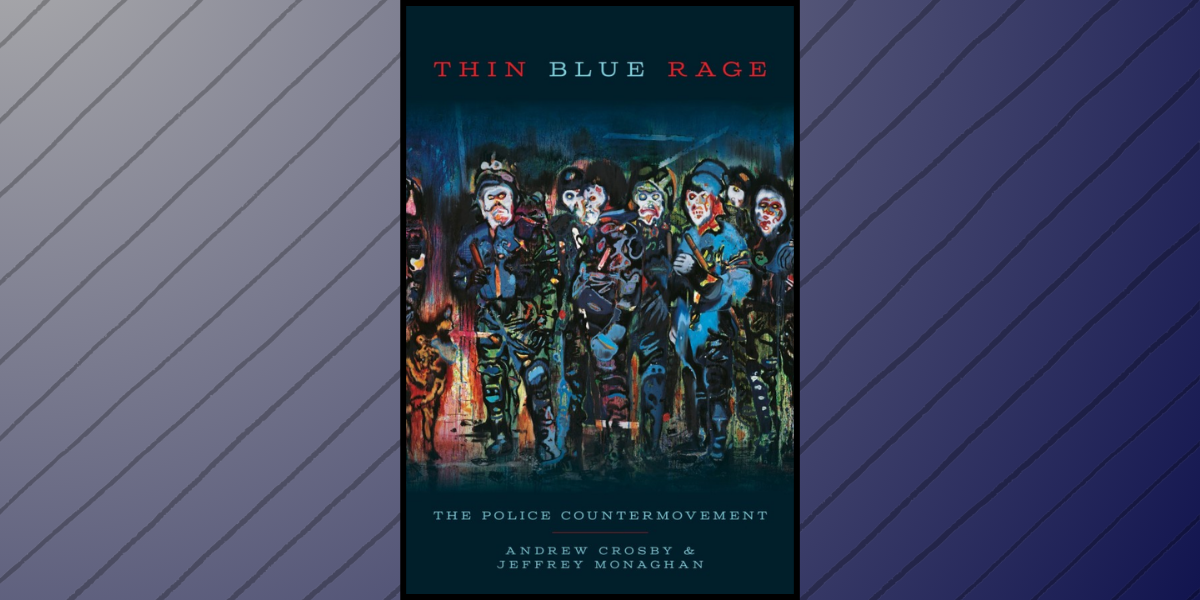
The years following the George Floyd rebellions have witnessed a significant upsurge in the power of police, whose budgets and resources have increased dramatically in an attempt to combat resistance against genocide, neoliberal austerity and rising authoritarianism. However, this rise in police power has also been combatted with an emerging proliferation of critical police studies.
From Alec Karakatsanis’s critique of copaganda, to Robyn Maynard’s updated edition of Policing Black Lives, to Mark Neocleous’s integral analysis of pacification as well as the founder of Sandy Hudson’s argument for the necessity of defunding, there is no shortage of arguments countering the dominant police narrative of safety. The latest installment within this critical genre is Thin Blue Rage: The Police Countermovement, which is focused specifically on the ideology of the police within the Canadian state.
A movement in power
From the outset, Thin Blue Rage cements its thesis of understanding police as a social movement, one that structurally aligns itself with reactionary politics to entrench the status quo of oppression and subjugation of primarily racialized communities. As noted early in the book, it has been the case that the study of movements has been neglected when analyzing conservative and far-right trends. The authors however embrace social movement studies to conceptualize police as an institution engaged in collective action, where their interests are advanced by means of organized mobilization corresponding to furthering conservative ideology. In this sense, the authors intend to challenge the dominant narrative of police as a neutral, democratic institution rooted in maintaining public safety. Police not only combat collective action but are themselves actors constituting a collective identity beholden to their own interests.
To understand the police as a social movement alone however would be an incomplete review of Thin Blue Rage. What is further required is the understanding of police as a countermovement, functioning as a coherent collective while simultaneously upholding the legitimacy of the state. As the book puts it, blue power is a “movement within the state” that suppresses movements challenging the sovereignty of the powerful. Key to the foundation of countermovements is the ultimate cooptation of grassroots and working class rhetoric to intend to separate their interests as not being aligned with authority. This is where Thin Blue Rage displays perhaps its most important contribution to critical police literature, bridging the “war on police” within the ideological paradigms of the police’s role in maintaining the neoliberal order.
Blue victims
The way in which the police social countermovement operates is through framing officers as saviours of humanity, protecting the “civilized” from the anarchic adversary on the other side of the thin blue line. Required for this ideology to be maintained is not only constant fear of the public but that society be perceived as perpetually unstable, forever on the brink of falling into chaos if it were not for the cops. Hence why the line is thin.
It is because of this constant threat to order that police constantly perceive themselves as under attack, not only by criminals, waywards, and the wretched, but by the biased media, social justice movements, and the ungrateful public. Within this logic, police are never violence workers but victims in a war against them. Thin Blue Rage demonstrates how this mentality was behind slogans such as “all lives matter” and “blue lives matter” that arose following the murders of Black people by police in both the US and Canada, where police used victimhood to reinforce their legitimacy after they committed violence.
Thin Blue Rage takes the thin blue line mentality a step further however, arguing that police don’t just seek to gain “equality” in the recognition that their lives matter too, but that police perceive their lives to value more than those they exist to oppress. Such a superiority-minded ideology leads to a constant state of dissatisfaction of the public response to their “heroic” actions of saviourism, inevitably coalescing into officers turning inwards to find veneration. Enter police culture, or the “way of life,” that frames police as a brotherhood in which they can only trust each other as the true knowledge-keepers in their fight against the perpetual enemy. Any criticism of police actions, including from officers themselves, is perceived as an hostile attack on this way of life.
Blue solidarity
One of the more prevalent examples Thin Blue Rage utilizes of police inability to take criticism is from the actions of the Toronto Police Association (TPA), the notorious union for law enforcement in the city. In response to a ground breaking Toronto Star report in the early 2000s that exposed racist carding practices of TPS, TPA launched a $2.7 billion class action lawsuit against The Star. Following the 2016 Black Lives Matter protest at Pride Toronto that demanded for police to not be included in the parade, TPA lobbied for the defunding of Pride under the presence that their efforts to “build trust” with the LGBT+ community had been diminished.
While Thin Blue Rage does not focus directly on the infiltration of police and prison guard unions within organized labour movements, it offers a substantive analysis of how carceral forces take advantage of collective mobilization strategies to frame themselves as part of the workers struggle. What becomes further revealed is the ultimate contradiction of blue solidarity. One on hand, police leverage collective bargaining power to push their interests. One the other, the police exist to suppress the very working class struggle they desperately claim to be a part of. I have written previously on how this contradiction operates in OPSEU, who continues to represent prison guards and push narratives that align with prison expansion in Ontario.
Thin Blue Rage understands that in order to defeat police power we have to know how police think. We have to understand cops not as neutral arbiters of the law but of violence workers, forever dependent on maintaining an unstable crisis perpetuated by antagonistic forces. All carceral narratives become siphoned through this framework intent on maintaining capital and racial relations of our time.
Author

Did you like this article? Help us produce more like it by donating $1, $2, or $5. Donate