
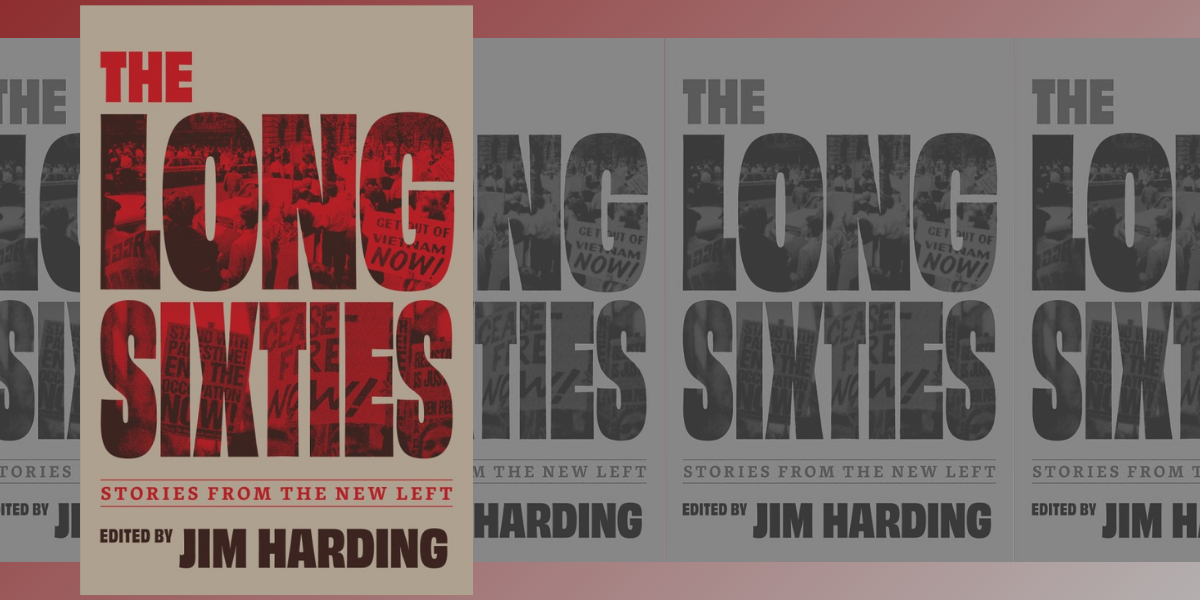
The Long Sixties: Stories from the New Left, edited by Jim Harding (Fernwood Publishing, March 2026).
The Long Sixties brings together seven Canadian leftists who became politically active as students in the 1960s. They share reflections on their decades of activism across Canada and offer useful insights for those of us looking to rebuild the left today.
What was the New Left?
The activists whose stories comprise this book identify with the New Left — a political movement that arose out of the 1960s, a decade of social, political and cultural upheaval across the globe. Shaped by their university campus milieus, most of the book’s contributors became politicized by the nuclear disarmament and anti-war movements during the Vietnam war. This was a time not so different from our current moment, when Canada’s economic reliance on the U.S. and its war machine agenda was a live debate across the political spectrum and within the left. Student revolts in the U.S. and Europe, as well as national liberation struggles in the global south, the Red Power and American Indian Movement, feminism, and the Civil Rights movement were also major influences on young activists at the time.
While there are important critiques of the New Left, this book sheds light on the influence its principles of participatory democracy, equity and community organizing continue to have on social movements today.
Here are some key lessons I took from The Long Sixties:
There are no single-issue struggles
There is a strong emphasis by these veteran activists on the need to make links across movements for social, economic and political change.
Contributor and editor Jim Harding, who grew up in Saskatchewan, began his life in activism as a high school student, organizing a protest against a trade show for nuclear bomb shelters. While criticism of U.S. imperialism and warfare was central to Harding and his co-authors’ activism, they were also deeply influenced by U.S. social movements. Harding participated in the March on Washington as a university student and returned to his campus with a deeper understanding of the intersection between militarism, racism and colonization. His anti-war organizing became inextricably linked to the Red Power movement for Indigenous sovereignty, which in turn led to involvement in environmental activism. For Harding, to be an anti-war activist was to be an anti-colonial, Civil Rights, and environmental activist.
Cathy Walker is the daughter of a feminist activist and a trade unionist from Burnaby. She joined the Women’s Caucus at Simon Fraser University, who were looking to grow their movement and decided to make the right to abortion a key campaign. They organized an Abortion Caravan inspired by the On to Ottawa Trek of the Great Depression. Walker reflects on tactical lessons learned through her experience with the Abortion Caravan, from campaign messaging to direct action. It took 18 more years of action before abortion was legalized in Canada.
Walker’s politics continued to develop over these years; it was through feminist and anti-war organizing that she gravitated toward labour activism. She became involved in building independent democratic trade unions as a rank-and-file worker, and eventually went on to organize significant changes to Occupational Health & Safety policy within industrial unions. She writes, “Occupational health and safety is at the heart of confronting capitalism. Workers give up their lives, their limbs and their health while employers only risk profit… Workers’ control over the workplace is needed, including what is done, produced, and how.” For Walker, women’s issues were also working class issues and environmental issues, and organizing on these shared fronts brought about lasting wins.
We fight for each other, not for the ruling class
A reflection that echoes throughout each chapter of The Long Sixties is the importance of creating accessible ways for people to engage in collective action. Meeting people where they’re at, working to understand their lived realities, and respecting their knowledge were key to the political development of these activists, whose organizing work started on campus but moved into working class communities.
Like many fellow contributors, Joan Newman Kuyek joined her campus chapter of the Canadian Union of Students. She also joined the student newspaper. After she graduated she began working for the Company of Young Canadians Organizing Committee (CYC) — which other contributors note was an attempt by the Canadian government to defang the groundswell of youth militancy at the time. She met organizers from the Student Union for Peace Action (SUPA) and, like Harding, drew inspiration from peace and Civil Rights organizing in the U.S. This sharpened her ability to work strategically on community development projects within the CYC — until realizing that she couldn’t overcome the contradictions in attempting to build transformative power from within a government agency. Her brief stint as a city councillor in Kingston, Ontario, where she was involved in anti-poverty and tenant organizing, reinforced this lesson: “The rules of procedure prevented any real challenge to that power. The only thing that could make that power blink was organized and sustained protest from an increasing number of people.” Kuyek eventually moved to Sudbury, where she continued organizing and writing. She wrote a book for her Bell Canada co-workers, linking their experiences to what she was learning about capitalist exploitation. She also helped form Women Helping Women, which undertook community-based research and distributed booklets on topics ranging from birth control to tenants’ rights.
Not ignoring or repeating, but learning from the past
There is a helpful honesty among this book’s contributors about how much things have changed since they entered into activism. They were the beneficiaries of lower cost post-secondary education, an upswing in the development of social housing, and a more robust landscape of progressive institutions and organizations. Several contributors were able to spend significant time travelling and participating directly in building an international peace movement. Many found decent jobs upon leaving university in urban centres around the country.
More than a half century later, we’re still fighting Canada’s complicity in imperialist wars and genocide in the midst of an ever worsening climate crisis, all while racism and sexism persist fuelled by right-wing reaction. Youth unemployment is at an all-time high, while students are fighting cuts to funding for post-secondary education in Ontario.
The Long Sixties offers not only accounts of the good times, but critical perspectives on why the New Left wasn’t more successful at bringing about lasting change. Lib Spry speaks of factionalism that emerged; groups turned inward and became caught up in debating “their particular theoretical version of how to run the revolution.” Dimitri Roussopoulos reflects on decentralization as a value of the New Left, but notes that it also had a weakening effect: “These separations, with no serious attempt to have all radicals work together, was fatal for radical politics.” Peter Warrian discusses the drift of youth activists toward “the long march through the institutions” — professionalizing and, for many, leaving their radical politics behind.
In the end, The Long Sixties offers neither a playbook nor hollow inspiration, but something far more valuable to socialists today: lessons both bitter and sweet from the direct experiences of seasoned organizers who remain politically active to this day. We’ve got a lot of work to do to grow our movements, but those who’ve come before help us remember that we’re never starting from scratch.
Author

Did you like this article? Help us produce more like it by donating $1, $2, or $5. Donate