
Working for Nothing: A Wages for Housework Anthology, edited by Louise Toupin (Between the Lines, 2026).
Working for Nothing animates the International Feminist Collective, better known as Wages for Housework since the 1970s, through a collection of its most important texts by Italian and American Marxist feminists, bringing its relevance to the current day when women’s livelihoods are as precarious as ever.
Wages for Housework as a revolutionary demand
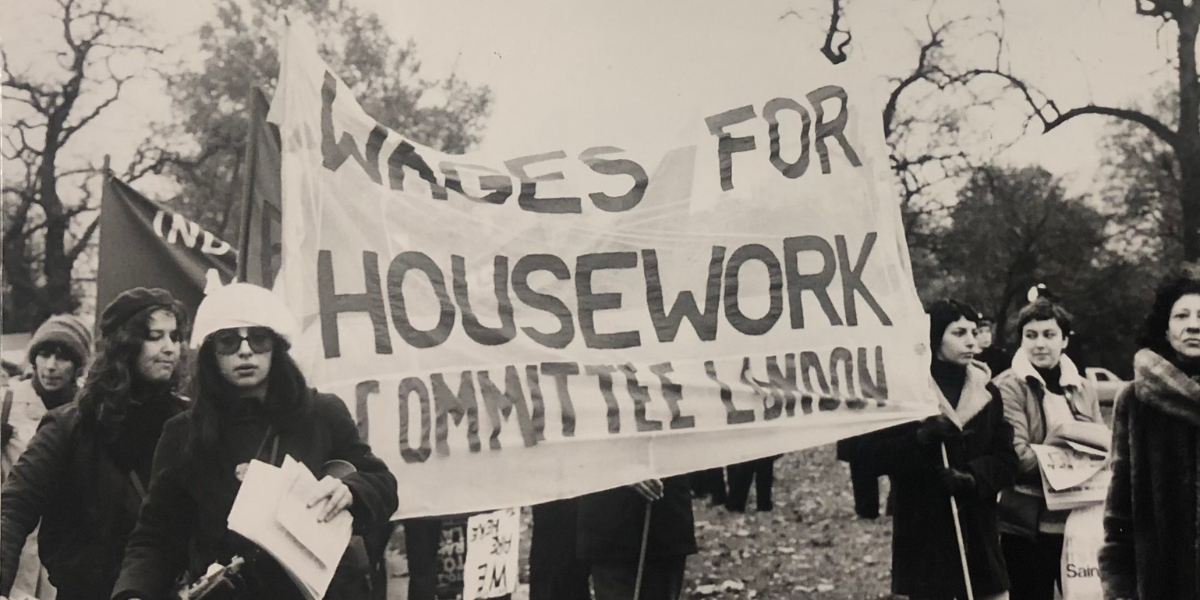
In the mid-1970s, the Wages for Housework movement was sparked by the pamphlet The Power of Women and the Subversion of the Community, which reimagined women’s labour — mainly invisible, unpaid, or underpaid — as the site for revolutionary struggle. It was theorized as a united front for all women to fight back against unpaid labour while expanding the imagination of invisible and gendered work at a time when these links weren’t clear on the Left. The anthology lays out these founding texts, debates, and calls to action chronologically to not only give access to this movement and its radical ideas, but also its evolution, and for us as readers to find its legacy in our movements today — from our demand for affordable childcare to decriminalizing and fighting for dignity for sex workers.
By situating the movement as part of wider struggles everywhere, and within the Marxist tradition, it also offers an important critique of how women’s labour was only made visible when it was outside the home, and as a result their place in the struggle was deemed secondary by many, including many scientific socialists. The key demand was framed as wages for housework so that women can have the social power to refuse work and fight to improve the conditions under which they are forced to work at home. They saw that housework is what millions of people around the world have in common and gives them a basis of unity to fight back.
The demand for wages for housework calls to order the unpaid work that sustains capitalist modes of production outside the home and reproduces it. Silvia Federici and Nicole Cox point out how American capital was built on slave labour and unwaged labour and continues to be built on the unpaid labour of many fields, kitchens, and prisons in the United States and abroad. The fight was seen by many in the movement as using the site of oppression as resistance against the systems that demand unpaid labour. Federici asserts that the struggle is not for a fair redistribution of the work but putting an end to unpaid work and the constant state of exploitation women find themselves in for the accumulation of capital. They saw the first step of breaking this system of accumulation as putting a price tag on it.
While these ideas have been debated since then, the most radical contribution of the movement and its writings is the call for organizing struggle on various fronts, rooted in where most women were and yet in effect excluded. This explains why women-dominated jobs like childcare, care work, and nursing reproduce housework and remain most often underpaid to this day as these jobs are expected to be performed for free at home.
Wages as lever for power
The movement is essentially rooted in an autonomous search for women’s power in capitalist society. While they see themselves in the Marxist tradition, many leaders in the Wages for Housework movement saw that relationship as secondary to the struggle for autonomy and against the subordination of women at home.
The texts call for the recognition of the thirteen or more hours of unpaid housework that women perform, often on top of their underpaid waged work in the factories. The isolation of women, dependent on another person’s wages at home, can only be broken with their own wages. Federici builds on this thesis and asserts that obtaining a wage gives women the power to refuse the unpaid work that they are subjected to and refuse housework as they see fit.
The movement’s demand is misunderstood as a simple demand for wages for gendered housework, however the main arguments put forward in the texts outline a broader demand that ultimately transforms the poor conditions under which women are forced to work at home and to refuse this work as they wish to leverage social power against the system.
From wages for housework to fair wages for all women
Mariarosa Dalla Costa explains that women are not only forced to work without a wage at home but they are also forced to work with poor quality nurseries, parks, laundries and other services. Working for a measly wage in the factory or school is the only option available to women who want a wage or independence. Because of this imbalance, women are paid less than their counterparts in the workplace when they already perform much of their labour for free at home, diminishing their social power. Therefore, by opening the demand for wages for housework, they hope that no woman will be forced to work for less than what they are worth in the factory if their work was compensated at home.
While their writings originated over 50 years ago, the conditions of women’s work remains much the same where women still make less than men, and jobs linked to “women’s work” remain mostly underpaid as they are expected to be done for free at home. Social services are a good example here in Canada, where over 70% of those employed are women, many making close to minimum wage, with stagnant funding and stolen wages right here in Ontario.
The writers are keenly aware not only of the weaponization of unpaid housework to drive down wages for women’s work outside the house, but they also recount experiences of women’s demands beyond wages — such as childcare, contraceptives, and abortion — being met with the response that the “till is empty,” that the government simply does not have enough money to improve the conditions under which women work at home and outside. These arguments are resonant today, as government dollars are never there for public services or wages but remain abundant for warfare.
In effect, the movement is also for radically reshaping and fighting for public services, schools, reproductive healthcare, green spaces, and all the things that are undervalued under capitalism.
Linking our struggles and the fight for liberation
The anthology presents the founding texts and debates in the movement, but also highlights the breadth of the movement in linking the struggle for better schools, better social services, racial equity, and rights for sex workers and lesbians who were often divided and forced to fight on multiple fronts.
However, Leopoldina Fortunati, in the final chapters, points out on the question of sex workers that:
“All work is prostitution, and we are all prostitutes. We are forced to sell our bodies — for room and board or for cash, in marriage, on the street, in typing pools or in factories. And as we win wages for all the work we do, we develop the power to refuse prostitution — in any of its forms.” (pg 211)
The anthology brings to light revolutionary ideas and debates in the movement to redefine women’s work in the house — all of it unpaid — and its necessity in upholding capitalism. The urgency in the texts from feminists across borders suggests that wages and the right to withhold labour are the only lever of power that women can wield to change their conditions within the capitalist system.
For younger feminists on the Left like myself, much of this urgency feels true today: public services are always on the chopping block, labour that is considered women’s work remains underpaid, workers are forced to operate under untenable working conditions, and we see direct attacks on women’s bodies everywhere — from barriers to accessing abortions to rampant sexual violence.
The energy and coordination to link struggles and fight against unpaid labour opens the fight for fair wages and decent working conditions for all of us — from migrant workers and student workers to prisoners and all those whose autonomy to refuse work has been undermined by the ruling class.
Author

Did you like this article? Help us produce more like it by donating $1, $2, or $5. Donate