
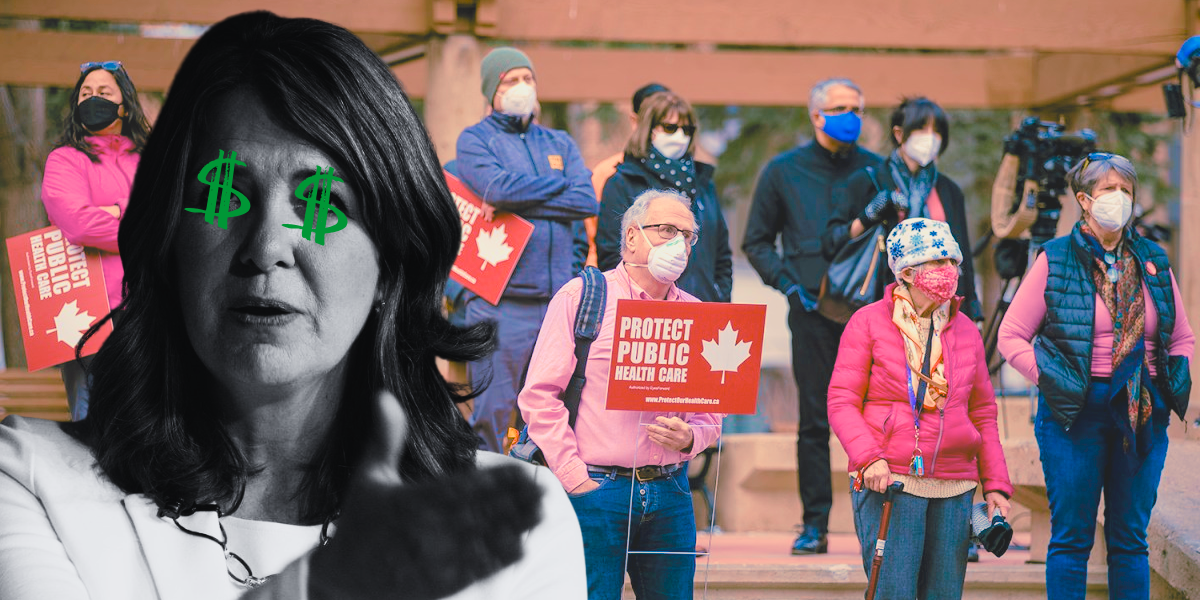
Canada’s public health care system is designed to limit the role of market forces in essential medical services. The Canada Health Act establishes rules that prohibit extra billing and user fees for medically necessary care in order to protect equal access and allow governments to plan services effectively.
Alberta’s Bill 11, expected to be implemented in 2026, changes this structure by allowing physicians to bill the public system while also charging patients privately for insured services. This policy change alters how health care resources are distributed and creates negative consequences for everyday people. If Bill 11 passes, it will greatly weaken Alberta’s public health system by encouraging profit over health outcomes.
Privatization means health care for the rich, not for all
Creating new channels for private profit will not improve the health care system. Health care capacity is limited primarily by the number of available professionals, not by patient demand. Bill 11 does not increase the number of doctors, nurses, or treatment spaces. Instead, it allows physicians to shift some of their work toward privately paid services. When higher payments are available, providers are more likely to allocate time to those services. This leads to fewer appointments and longer wait times in the public system. For patients who rely entirely on publicly funded care, access becomes slower and less predictable, as noted by the Ontario Health Coalition.
Everyday people experience these effects consistently. Patients may be told that a service is available sooner if they pay privately, while the publicly funded option involves a long delay. Although care is still technically available, the wait itself becomes a barrier. Delayed access can worsen health conditions, increase stress, and lead to more serious and costly interventions later. People with lower incomes are more likely to postpone or avoid care when faced with these delays, even when the medical need is significant. Evidence from Canadian Doctors for Medicare shows that mixed public-private systems often experience this redistribution of care toward wealthier patients.
The legislation also shifts decision-making power away from patients. Under Bill 11, physicians determine whether a service will be publicly insured or privately billed. Patients are placed in a position where they must either accept the cost or attempt to find another provider. In practice, this reduces patient choice because alternatives may be limited or unavailable. Access to care becomes dependent on a person’s financial situation rather than solely on medical need.
Over time, this model increases inequality within the health system. Higher-income individuals are more able to pay for faster access, while others remain in the public queue. This creates a two-tier experience even if the system is still officially described as universal. Research on mixed public-private systems shows that this structure tends to weaken public services rather than improve overall efficiency, as discussed in studies summarized by the Canadian Centre for Policy Alternatives.
Long-term consequences the of public-private model
There are also long-term cost consequences. Expanding private payment and insurance for essential services increases administrative expenses and encourages price growth. These costs are ultimately passed on to individuals through insurance premiums, out-of-pocket payments, or reduced public funding for other services. What appears to be flexibility in the short term can result in higher overall costs and reduced system stability. Comparisons with the United States show that private insurance often leads to higher spending and inequities.
This redistribution has many consequences. Cities with wealthier patients may attract more flexible physicians, leaving rural and low-income areas with fewer doctors and longer waits. Public resources, which are already limited, may have to be used to support doctors who work in both public and private systems or to manage care that is split between the two. Over time, this could make public services less predictable and more difficult to rely on, forcing patients to figure out other ways to get care, quickly.
What looks like “choice” for patients means that money decides who gets faster or better access, and efficiency focuses on profit instead of health. The long-term effect is not only reduced equity but the potential normalization of a two-tier system that fundamentally undermines the principles of universality and social solidarity in health care.
The fight for equitable, universal health care means opposing Bill 11 and all other attempts to turn health care into a profit-seeking venture. The future of our health care system, and our lives, depends on it.
Author

Did you like this article? Help us produce more like it by donating $1, $2, or $5. Donate