
Picture this: you’re scheduled for 7:00 am, because you must be at your job—whatever it may be—before 8:00 am, when the worksite opens. You arrive at the scheduled time, prepare everything for the day ahead, and at 8:00 am, you continue with your tasks. An hour later, you leave the workplace, because that is what is required to do your job, and you continue working for several hours until you return to the employer’s site at 3:00 pm. You stay there until your shift ends at 4:00 pm.
You’ve been working for nine hours. But when you finally see your pay stub, you notice that you were only paid for the three hours you were on site.
This is the reality for Air Canada flight attendants, and it’s why they’re defying back-to-work orders and fighting for their rights.
All clear to go
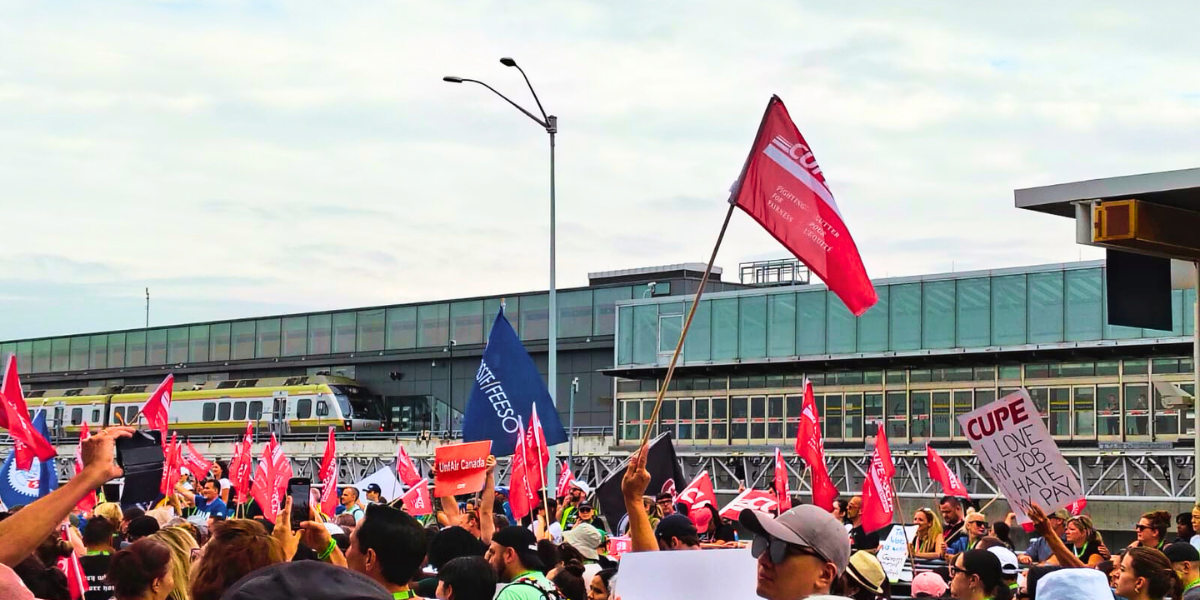
As of 1:00 am on August 15, Air Canada flight attendants walked off the job as their union, the Canadian Union of Public Employees (CUPE 4092), decided to strike, with a 99.7 percent strike mandate. Members are seeking to end unpaid work, in addition to a pay increase. Flight attendants have only received a $3.00 raise since 2000, while inflation has increased by 69 percent and Air Canada had its most profitable year in 2024, earning $22.3 Billion in revenue.
Air Canada states that it offered the workers a 38 percent pay increase over the course of four years. The company attempts to bolster the appeal of the offer by providing numbers that, without context, appear to be higher than the average wage. However, CUPE has explained why it is insufficient: namely, the offer does not provide pay increases that match inflation and provide full payment for work performed. It should be clear to anyone who examines the company’s clarification that this is no more than an attempt to make workers appear unreasonable for not accepting the offer.
One of the first tasks that the flight crew must complete is a pre-flight check, one of the most important tasks that a crew performs. This involves checking all safety equipment and systems to make sure they’re working and will be available in an emergency. Flight attendants completing these tasks face an unfortunate reality: if the job is being done well, we as passengers will never notice. If it is not done well, it is adamantly clear.
These tasks are often thankless but ensure that flights are safe. Air Canada sees the necessity of this work as it protects them from liability if a passenger is hurt by something falling out of the compartment or tripping on something left in the aisle. So, why do these workers remain unpaid for this work?
Bad flights and bad faith
The same day the strike was announced, Jobs Minister Patty Hadju, representing the federal Liberal government, invoked section 107 of the Canadian Labour Code. This means that workers were, legally speaking, being forced back to work.
Air Canada was relying on this. As a corporation, it is illogical for Air Canada to proceed with contract negotiations in good faith. Are they required to? Yes. Morally, is it the right thing to do? Absolutely. However, as a business practice, it would be unwise.
If you were negotiating with someone about a payment plan and you knew that you could hold off on making a deal, because if you waited, your parents’ best friend would then set the terms of the agreement that you and the other party would have to abide by, wouldn’t you also wait for that outcome? This is what Air Canada workers are up against.
With Minister Hadju’s declaration, the next step would be for the chairperson of the Canadian Industrial Relations Board (CIRB) to assign an arbitrator to set the terms of an agreement. The person currently in that role is Maryse Tremblay. In her life before becoming the chairperson, Tremblay acted as senior counsel for Air Canada from 1998-2004. In that role, she negotiated on behalf of Air Canada in the exact negotiations the company has been engaged in for almost a year. Tremblay won’t be the arbitrator reviewing the deal, but it should be clear why workers are concerned about impartiality.
Defiance
On Sunday, August 16, in front of thousands of folks gathered at Lester B. Pearson airport in Toronto, Ontario, Mark Hancock announced CUPE’s plan to defy the back-to-work order. This defiance is unprecedented in post-Charter Canada. The last federal union to defy such an order was the Canadian Union for Postal Workers (CUPW) in 1978. At the time, CUPW was tired of dealing with a federal government—then the direct employer for Canada Post—which was bargaining directly with the workers, as opposed to going through the Union. Consequently, the CUPW president, Jean-Claude Parrot, was arrested and jailed for three months. Although CUPE has had success fighting back against similar orders at the provincial level, this is truly untested water.
Public support
Navigating these troubling waves will require public support. Luckily, the union appears to have exactly that. Recent Abacus polling showed that 59 percent of the Canadian public supports the Union, while only 12 percent support Air Canada. For anyone who has ever dealt with Air Canada, it is easy to see why.
Part of the reason for this support could be related to the recent turmoil resulting from the current tariff crisis. Although Mark Carney’s government is still enjoying public support, Canadians remain concerned over the lack of stability emanating from the current conflict with our neighbour to the south. With the government showing its cards as to who it supports—corporations, not workers—the public’s support of Carney might be fleeting.
For many, it is confusing that the government is capitulating to a widely detested corporation so that they may benefit from free labour; however, a reading of the Communist Manifesto provides the answer. Marx and Engels wrote that under Capitalism, the State is responsible for managing the affairs of Capital. Hopefully, the 30 percent of the Canadian public that remains undecided on this issue will soon realize that when getting through a trying time, support will come neither from technocrats nor capitalists; it will come from below, where we all reside.
Author

Did you like this article? Help us produce more like it by donating $1, $2, or $5. Donate