
As Trump took to Twitter to threaten a potential nuclear strike on Iran in April, many users on the platform and other social media cried out for “someone” to “do something”. This has recently become somewhat of a common occurrence as the ruling class continues to wreak havoc on the working class by escalating its attacks from all angles. Whether it’s the housing crisis, massive job losses, or war, we know who our abusers are but we don’t know how to stop them ourselves, it becomes easier to hope that someone else will save us.
This mentality has influenced attitudes towards political engagement for some time now, eroding not just the morale of the masses, but their confidence in fighting for any kind of positive change for the greater good. As leftists, we know that despite the presence of influential figures, only the working class can save itself through collective struggle, but one of the biggest challenges we face is how to build the confidence of the class at a crucial time when people are only beginning to gain class consciousness but don’t know how to get involved. This inability to visualize any paths towards a better future is in part due to conditioning under the capitalist system, and we have a responsibility to provide our new comrades with hopeful possibilities as we welcome them into our community, no matter what stage of life they’re at.
Some allegories that symbolize the power of community and collective struggle can be found in nature, such as elephants, bees, and ants. It was the latter that inspired two competing family-friendly films back in 1998: Dreamworks’ “AntZ”, and Disney-Pixar’s “A Bug’s Life”. While both films surprisingly examine the awakening to class consciousness of the individual within the community, it’s “A Bug’s Life” that makes for a better reflection of learned helplessness in the face of oppression that resonates with the current climate, and is therefore worth revisiting as a reference for those trying to break free from this cycle.
Class dynamics, bug dynamics
Spoilers ahead
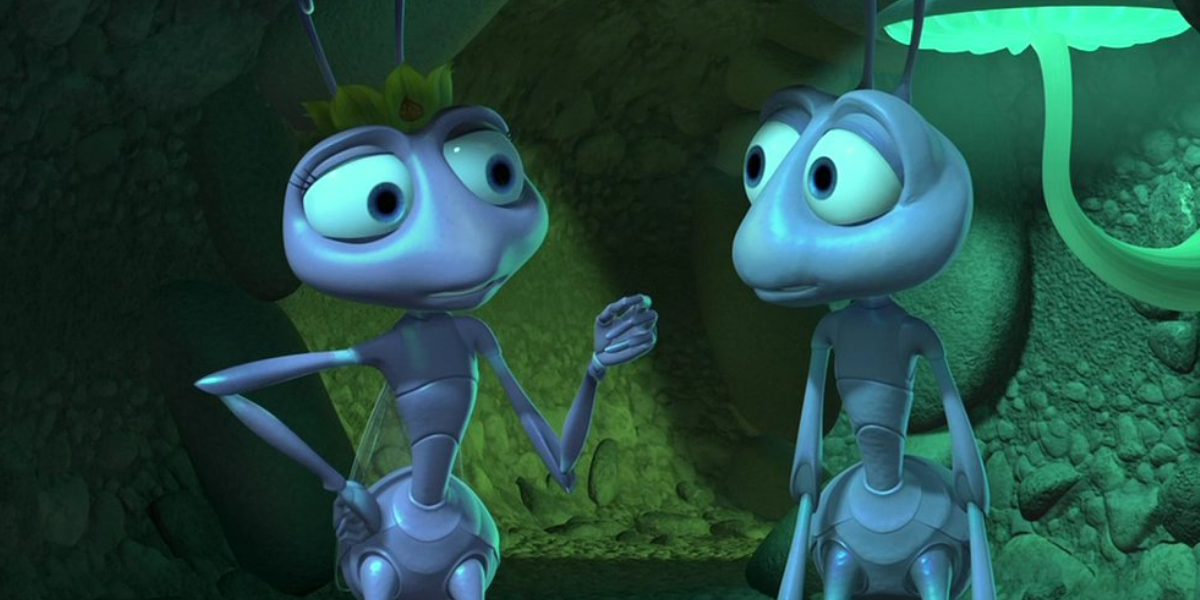
The film follows Flik (voiced by Dave Foley), a well-meaning worker ant whose attempts at improving conditions for his colony are often overlooked or dismissed by the other ants as hindrances to the status quo, which sees the ants paying tribute to an intimidating gang of grasshoppers led by Hopper (Kevin Spacey) in the form of a seasonal stockpile of food in exchange for protection from hypothetical threats. After Flik accidentally spills the entire offering right as the grasshoppers arrive to collect, Hopper demands double the amount of food by the end of the season.
Unable to produce as much food not just for the grasshoppers but also the colony itself, Flik suggests instead to recruit other bigger bugs to protect the ants. On his search, Flik comes across a troupe of recently fired circus performers who he mistakes for warriors, and through a mutual misunderstanding they agree to go to the colony. Right as the grasshoppers return, the truth about the troupe is revealed, leaving the ants scrambling to fulfill Hopper’s demand and with the colony now under his rule.
Unlike many villains who often regard the general population as “ants” because they perceive it as weak, Hopper uses the threat of violence to keep the ants in check because he is well aware that while one ant may be weak in comparison to a grasshopper, it’s actually the ants that outnumber and could easily take on him and his gang. In one scene, the grasshoppers are frolicking in the bug-equivalent of a Mexican beach resort, but he makes it a point to cut their vacation short and return to the colony simply to assert their dominance. For him, it’s not about food or even survival—it’s about control.
The ants, on the other hand, have no concept of their own autonomy and cannot visualize an alternative where they thrive on their own self-determination. Even their queen and princess (Julia Louis-Dreyfus) have normalized this passivity. They’ve outsourced their safety to the grasshoppers who abuse them and later to the circus performers who deceive them, rather than protecting their own colony themselves.
Helplessly hoping for a hero
This analogy of people as ants can often be found in “chosen one” type of stories (like in “Superman,” “The Matrix,” or the Harry Potter franchise) where an individual hero archetype is predestined to save others from larger, external threats, a genre which remains very popular among audiences. These narratives perpetuate the paternalistic notion that as a collective, we can only be saved by a higher power or an individual, and it seems like more than a coincidence that they happen to take place within the realm of fantasy.
Similarly, as our elected officials continue to gut essential services in order to fill the pockets of private entities, the ruling class has been increasing the militarization of the police while also narrowing the scope of what constitutes legal forms of dissent, thus limiting any avenues the working class has to defend itself and instead leaving them hoping for saviors, whether they’re political figures like Hillary Clinton or Zohran Mamdani, or in more extreme cases, another Luigi Mangione or Chamel Abdulkarim (a.k.a. “Warehouse Luigi”).
However, while “A Bug’s Life” may center around Flik as a protagonist, his story is not individualistic. Being the only dissident in the colony, he is mocked at best and ostracized at worst, but it’s not until the climax of the film where he speaks about the strengths of the ants as he stands up to Hopper that the ants realize that they’re not helpless like Hopper has made them believe. Once they achieve this breakthrough, the grasshoppers aren’t able to put up much of a fight against them and quickly leave knowing that the ants will never be subdued again.
Flik’s journey is tied to the growth of the ants in the colony. He’s not the hero that saves them; they ultimately save themselves because he reminds them that they’re stronger together. Individuals will not usher in revolution by themselves. They may bring forward ideas that can spark broad movements, but ultimately, only the working class is the “someone” who can “do something” for itself. Perhaps more Luigis and Chamels wouldn’t seem as necessary if people were willing to hear out the Fliks in real life.
Lessons for all ages
While animation as a medium is often categorized as geared towards children, dismissing family-friendly animated films as “just for kids” is not only myopic, but a form of media illiteracy — many animated, family-friendly films truly contain lessons that even adults would benefit from. “A Bug’s Life” skillfully simplifies the language of class consciousness enough to introduce it to younger audiences while remaining solid enough for hesitant adults who need to see that they too have the power to change their collective circumstances. With the ongoing banning of books, symbols, phrases, and other media critical of the ruling class, it’s important to amplify what remains, especially when it’s accessible to all audiences.
As Disney continues to absorb media outlets and monopolize the public’s imagination, it wouldn’t be much of a mystery why this particular film has sat for almost thirty years collecting dust in the vault as they capitalize on other Pixar successes. Thankfully, The Revue Cinema in Toronto will be having a special screening of “A Bug’s Life” on May 23rd at 4pm. Tickets are available here.
Author

Did you like this article? Help us produce more like it by donating $1, $2, or $5. Donate